Showing posts with label Year 2 Narrative Movie Reviews. Show all posts

Friday, 2 December 2011

Movie Review - Who Framed Roger Rabbit


The director, Robert Zemeckis has created 'Who Framed Roger Rabbit' as a parody of the Film Noir genre shown in it's characters and the real world of the film. The plot is also typically noir because it includes the detective element through in the character Eddie Valiant. “...the camera follows Roger from the brightly coloured cartoon set into the real world of 1947 Hollywood, making this transition with the supreme ease that is this film's greatest achievement. However wildly inventive the Toon-human interchanges become, they are executed with the utmost sang-froid.” (Maslin, 1988) All costumes and sets had to have a typical 40's feel to make the world for the film feel right for the film noir atmosphere that it wanted to imitate. Also typically lighting and camera techniques such as the use of exaggerated shadows were used to make the connection with the genre.The animated characters also had to fit the real world so were portrayed differently in the 1947 world of the film, given a three dimension quality through shading so that they wouldn't feel flat compared to the human characters. These rules were reversed in the 'Toon Town' universe where the animated characters could once again become the flat - like characters the audiences would except in a cartoon universe. The colours also became much more vibrant and bold to create the sense of a completely different world compared to the film noir approach used in the human world.


Figure 1, (2011), Mixture of human and toon characters

There was a political agreement that Zemeckis had to address with Warner Bros and Disney, to make each sets of characters equal and not making one character from one particular corporation seem more important than the other. “The combination detective noir story, slightly adult humour, crazy toon characters from both Warner & Disney's vaults (a one-off which is unlikely to ever repeat) and overall technical wizardy yielded a film which set a precedent.” (Franklin, 2010) Figure 2 shows one particular point where Warner and Disney share the stage as Valiant plummets to the ground, Mickey and Bugs Bunny fall beside him at opposite ends to create perfect symmetry of space taken up by each character. Another example of this is the scene where Donald and Daffy Duck are trying to play the piano in the nightclub, both characters try to outwit each other. However to keep to the idea of symmetry both characters have about the same amount of occasions to appear on screen as they both perform a series of gags to stop the other character stealing the spotlight but they don't finish. As one characters remarks in the film 'Those Ducks are very funny because they never get the chance to finish their performance' tells the viewer that this was for the purpose that one character would never be dominate and finish the performance.


Figure 2, (2010), Mickey and Bugs Bunny – Warner Bros equal to Disney

Another important feature of the animation was that it was done as a live action to get the right interaction between human and cartoon character. “Zemeckis and his team of special effects people put forth great visual effects, animation and matched it with great camera movement for the live action; they also presented the cartoon characters with a glowing 3-D effect. It was a monumental effort in technology that still doesn't seem dated.” (Schwartz, 2008) Using the 3D effect for the characters allowed them to feel present alongside the human characters to create a co-existence that could be believable to the audience. The 3-D quality also allowed the animated characters to appear to react with the real world environment so they could have that advantage in that universe and not be flawed to boundaries of an ordinary cartoon. Similarly Valiant had rules that allowed him to interact with cartoon objects such as his gun and the hammer that eventually defeats the villain 'Judge Doom'. This also allows Valiant's character to be part of the 'Toon Town' world which he is forced to go back to in search of Roger Rabbit.


Figure 3, (1988), Roger Rabbit and Valiant


Illustrations

Figure 1, (2011), Mixture of human and toon characters, @ http://www.availableimages.com/movies/1988/whoframedrogerrabbit/pictures.html, Accessed on: 9th November 2011

  Figure 2, (2010), Mickey and Bugs Bunny – Warner Bros equal to Disney, @ http://www.neatorama.com/2010/01/27/movie-trivia-who-framed-roger-rabbit/, Accessed on: 27th January 2010


Figure 3, (1988), Roger Rabbit and Valiant, @ http://www.jonathanrosenbaum.com/?p=7661, Accessed on: 24th June 1988

Bibliography
Franklin Garth, (2010), Dark Horizons - Who Framed Roger Rabbit, @ http://www.darkhorizons.com/reviews/841/who-framed-roger-rabbit, Accessed on: 2010
Maslin Janet, (2003), The New York Times - Who Framed Roger Rabbit, @ http://movies.nytimes.com/movie/review?res=940DEFDD163FF931A15755C0A96E948260&partner=Rotten Tomatoes, Accessed on: 20th May 2003
Schwartz Dennis, (2008), Ozus' World Movie Reviews - Who Framed Roger Rabbit, @ http://homepages.sover.net/~ozus/whoframedrogerrabbit.htm, Accessed on: 9th February 2008


3/5


Friday, 18 November 2011

Movie Review - Blade Runner The Final Cut 2007


Blade Runner was influenced by Philip K. Dick's book 'Do Androids Dream of Electric Sheep and Ridley Scott made the first version in 1982, where he cleverly combined three genres of Science Fiction, Mystery and Film Noir. He made sure all the frames teemed with detail, or as Scott called it  'visual layering'. However the film had problems in it's story telling methods of Harrison Ford's narration at the beginning and the original 'happy ending' created confusion with the audience and the film disappeared and look set to be forgotten. However in 1992, Scott released Blade Runner: The Director's Cut where he edited out the narration and the original ending to be replaced with the unicorn daydream to suggest that the character Deckard could be a new generation version of replicant. The film became much more popular with the audience, as well other film makers who copied who copied Blade Runner's design for rock videos, TV shows and feature films. Twenty five years after the originally release, 2007 saw another version to hit the box office: Blade Runner: The Final Cut, a digital variant from the previous edition with shots and effects much sharper to create a polished version of the film for the generation of audiences today. This makes people think though of how many more versions of the film will be released where the line will be crossed as George Lucas continuously re-edits his originally Star Wars films to the point where audiences are slowly saying 'enough' and it asks the question 'will Scott ever be able to leave this film or will he continually try and re-edit Blade Runner until he considers it to his vision of a perfect film.'


Figure 1, (2011), Futuristic city with Inspirations of Tokoyo

The film is driven by it's environmental sets, where Ridley Scott has used specific lighting techniques and influences to make the genre and world appear believable to the viewer. "The secret of Blade Runner is that Scott's fantastically baroque, future-shock imagery, all dark decay and techno-clutter, effectively becomes the story. As the layers of mood and detail settle in, the very process by which we watch the film - scanning those shimmering, claustrophobic frames for signs of life - turns into a running metaphor for what Blade Runner is about: a world in which humanity has been snuffed by "progress". This is perhaps the only science fiction film that can be called transcendental." (Gleiberman, 2011). The narrative and visual world of Blade Runner sets itself into the period of 2019 - 2059 Tech/ Future Noir and centres it's message around progress. Despite having the feel of eighties costumes and characters the visuals convey to the audience of a time where humanity has advanced so much that they have become 'snuffed' and insignificant compared to it. Scott took influence from New York and Tokyo and their huge cities and advertisement screens to create the non existent world that could be metaphor of how far humanity could advance.


Figure 2, (2011), Pris, one of the replicates in the film

Blade Runner also questions life as an individual and what is a person's true purpose. "Moreover, it's science fiction with thought. Tyrell gives the Replicants memories so they don't know they're not human. Which makes Deckard wonder if he is really human, either. And that, in turn, asks us to think about ourselves, what makes anyone human, where we come from, where we're going, and what it means to be alive." (Puccio, 2007) Scott puts across self doubt into the character, Deckard as the whole purpose in the film was for him to track down four dangerous Replicants that want more life to break the barrier of a four year life, however subtle hints have been put into the film of Deckard's daydreams of unicorns to make the viewer aware that there may be more to the specific character. When the audience finally sees Rachael's origami unicorn, they come to realise that Deckard has been a new generation replicant and no longer the hero meant to protect but run for his survival.


Figure 3, (2009), Origami Unicorn

Even though Blade Runner was set in future, it doesn't try to become to out of reach of the real world as films in the Science Fiction genre would be. "Part of it's success is that it is rooted in the now, and doesn't go in for any far-out zipper suit version of the future. That plus the special effects are still spectacular, having a solidity about them that is lacking in many CGI effects." (Ehley, 2008) The Film clings tightly to it's Noir genre as much as the Science Fiction to bring aspects of past into the future. Scott has achieved this by using specific colours of chrome, blue and red to be the most highlighted to give the sense of a film noir world in colour. The characters also have typical roles within that genre, Deckard is an example of this as he portraying the detective archetype with his mumbling tones and body language as similar to Sam Spade in the Maltese Falcon. This explains to the viewer that Blade Runner has kept the air of mystery and the conflict of the good cop and the villain as a world and characters that could exist.

Illustration List


Figure 1, (2011), Futuristic city with Inspirations of Tokoyo, @ http://evade.com/beautifull-the-old-bladerunner-oc1/, Accessed on: 2011
Figure 2, (2011), Pris, one of the replicates in the film, @ http://www.listal.com/viewimage/1667350, Accessed on: 22nd January 2011
Figure 3, (2009), Origami Unicorn, @ http://blog.craftzine.com/archive/2009/01/how_to_blade_runner_origami_un.html, Accessed on:  15th January 2009

Bibliography
Ehley James, (2008), Movie Page - Blade Runner The Final Cut, @ http://www.scifimoviepage.com/dvd/bladerunner_finalcut-dvd.html, Accessed on: 19th March 2008
Gleiberman Owen, (2011), EW.com - Blade Runner, @  http://www.ew.com/ew/article/0,,311946,00.html, Accessed on: 7th September 2011
Puccio John, (2007), HD DVD review - Blade Runner, @ http://www.dvdtown.com/reviews/blade-runner/5452, Accessed on: 19th December 2007


3/5


Thursday, 10 November 2011

Movie Review - The Maltese Falcon


Film Noir literally means black film or cinema because of how dark or downbeat the themes are, Films of this genre reflected the tensions and insecurities of the time period and balanced the optimism of Hollywood's musicals and comedies. They reflect the Cold War period, capturing the emotive themes of fear, mistrust and loss of innocence. Film Noir focused on the evils of society, the criminal and violent and rarely led to a happy ending. Noir can also be broken down into sub genres, the first being neo-noir, which means a film set in modern times that shows characteristics of film noir in plot and style. Tech-Noir (Future-Noir) is a hybrid genre combining film noir and science fiction or cyberpunk. Space Opera Noir, a new class of the Space Opera genre derived from general science fiction of spaceship tales. B Movie Noir takes from the classic term 'B Movie' of being cheaply produced on a low budget and with extreme themes. Proto and Post Noir identifies the early and late stages of Film Noir. The Maltese Falcon slots into Proto Noir as it was released in 1941 and one of the first of it's kind.


Figure 1, (2007), The Maltese Falcon (Macguffin)

All the characters in the film are all derived around the mcguffin, the Maltese Falcon. "Initially, The Maltese Falcon may seem plot-driven but, when one considers that the falcon is actually a Mcguffin, the film can be seen as more of a character study. There are no traditional "good guys." Spade acts as he does not to honour the law but to fulfill his own personal code of honor, and belief that love can conquer all. In this movie... that's not the case." (Berardinelli, 2008) The audience can identify that the film uses the mcguffin to draw more performance into the film's characters and also centres the themes of betrayal and obsession as the characters strive to outwit each other to get what they want. The Mcguffin quickly sets the characters against apart and there is mistrust between Sam Spade and The Fat man on whether the falcon is genuine or if Sam would get paid for handing it over.


 Figure 2, (2007), The various character stereotypes

The central characters of Sam Spade and Brigid O'Shaughnessy give a real sense of noir genre playing cat and mouse throughout. "Bogat not only dominates the proceedings throughout, but is the major motivation in all but a few minor scenes. Mary Astor skillfully etches the role of an adventuress whose double - crossing is not disclosed until the final scenes." (Staff, 2008) Spade's character unintentionally has traits of the detective as he goes about asking questions about the murders that took place a couple of months before the film was set, using a mumbling technique to increase the pace of the dialogue but the film itself is much slower allowing the viewer to let the plot draw out and the secrets to reveal. The audience learn that the murderer turns out to be O'Shaughnessy, the character becomes suspicious when the fake falcon is drawn to light at the end of the film as she was meant to collected it. This evokes suspicion and doubt in Spade's character and becomes cold as he has finally caught the killer, the character puts his feelings for Brigid aside and takes on the full role of the detective as he hands her to police. At this moment the viewer witnesses the classic film noir ending and that Brigid has finally been caught and not even her love for Spade could of saved her.

Another important feature of the film noir genre are the use of camera angles and shadows for dramatic emphasis to a scene. "The shadowy staging, the obtuse camera angles, the constant potential for violence, the hard-boiled banter, the suspect morals of the good guy himself too long in touch with criminals and always rubbing shoulders with every manner of corrupt client - it's all here in spades, Sam Spades, that is." (Jardine, 2009) The strongest use of staging and shadows are depicted in the scene of Brigid's imprisonment, the intense close up angle of the camera and the striking use of shadows that falls across her face to visualise the characters imprisonment and cut off from Sam Spades showing the emotion of his personal betrayal for turning her in. The shadows throughout convince the audience of what character personalities might be hiding, all these staging techniques are important to show that the Noir genre is theatrical and staged like a play so that the viewer is forced to watch it play out.


Figure 3, (2011), Use of shadows

Illustrations


Figure 1, (2007), The Maltese Falcon (Macguffin), @ http://avaxhome.ws/video/maltese_falcon.html, Accessed on: 6th May 2007
Figure 2, (2007), The various character stereotypes, @ http://www.celluloidheroreviews.com/2007/02/13/the-maltese-falcon/, Accessed on:  13th February 2007
Figure 3, (2011), Use of shadows, @ http://cinepad.com/filmnoir/shadows.htm, Accessed on: 2011

Bibliography
Berardinelli James, (2008), Reelviews Movie Review - Maltese Falcon, @ http://www.reelviews.net/php_review_template.php?identifier=684, Accessed on: 10th June 2008
Jardine James, (2009), Cinemania - The Maltese Falcon, @ http://djardine.blogspot.com/2009/12/maltese-falcon-usa-1941-john-huston-ben.html, Accessed on: 23rd December 2009
Staff Variety, (2008), Variety Reviews - The Maltese Falcon, @ http://www.variety.com/review/VE1117792895?refcatid=31, Accessed on: 8th April 2008


2/5

Friday, 4 November 2011

Movie Review - Mars Attacks


The three main comedic genres that imitate and take inspiration from what exists already are spoof, pastiche and parody. A Spoof is a mocking imitation of someone or something, usually light and good humoured so works on trying to capture the stereotype of a person or thing that a viewer can recognise. A spoof can also mean to fool by hoax, to play a trick on someone intended to be deceived so in this case the audience could be the people deceived by what they think the film is showing but might turn out to be different from the obvious. A Pastiche imitates the style another work, artist or period so recreates something that has come before but keeping in some original features that make recognisable as an identity. A Parody is a production of a humorously exaggerated imitation of a writer, artist or genre. Mars Attacks fits into Parody because it mocks the culture of typical science fiction genre in terms of alien invasion and of the 1950's - 60's period.


Figure 1, (2009), The Aliens Arrival

The inspiration for Mars Attacks came from a popular 60's Topps Trading card game and of the period where design and Technicolour were exaggerated to show the achievement of technology at the time. "Although the intent and feel of the film, which is based on some rare Topps trading cards of the early '60's, are very different from "Independence Day", this pic's belligerent aliens and massive worldwide destruction they unleash, including the demolition of Washington DC Landmarks, unavoidably remind of the blockbuster. Burton's picture could even be construed as something of a satire of the summer's monster hit, although it was clearly made with no reference to it." (McCarthy, 2008) Mars Attacks was released roughly the same time as Independence Day and it is clear to see similarities in the structure of story line between them. Both alien races in the films are intent on destroying which is marked with the demolishing of major landmarks to create the serious impact to the viewer that the invaders have the potential of conquering the world within the film because they can topple structures that humans have built throughout history and stood for many years within a blink of an eye. However Mars Attacks is it's own film because Burton has exaggerated the appearance and technology of the aliens to outwit a 50's world and taken out the serious gimmicks that Independence Day fulfils for it's audience, instead Mars Attacks attempts to make it's audience laugh at the silliness of it's style and pathetic feel.


Figure 2, (2010), (1950-Influence) Army


Burton has used typical attributes of 1950's characters and style and brought this forward for the audience of the 1990's. Mashing them to create a world that could exist for the film. "Burton was forced to fill in with more bumbling burlesque character stuff - and since his players where nothing short of cardboard cut-out archetypes (dim President, warmongering General, New Age airhead, etc)..." (Gibron, 2010) Burton carefully selected certain stereotypes that would work in his 50's world influence. The character of Donald Kessler for example is a perfect imitation of an excited scientist, intent to learn about the creatures and trying to find a peaceful solution to co-exist. The character of Natalie Lake is another 50's stereotype of the dim blond news reporter always placing herself in harms way and the obvious victim that the director has chosen for all the disasters to centre around. The character has also traits of ambition as she continuously tries to gain attention from Donald Kessler as he is a professor of science, this translates to the audience as Natalie wanting a different lifestyle that her previous reporter husband in the film, Jason Stone could no longer fulfil.


Figure 3, (2010), Giant Robot (1950 B-Movie influence)

There is a lot of reference to arcade shooters because it begins with two typical children stereotypes obsessed on ditching school to play at the arcades which is later reflected in the style of the guns that the aliens use. "It's fitting that we almost get wiped out by the only species more warlike and testosterone-brained than we are, and Burton is at his funniest when the Martians are zapping away like brats playing a video game." (Gonsalves, 2010) The audience can see the same child-like obsession when they suddenly turn on the human characters and blast them for fun. The design of the aliens make them appear intelligent with their huge brains and promises of peace but under this they are an imitation of the human race because even though they have potential of sharing what they have, they chose to destroy and conquer in order to rebuild and create a new world for their species. This is how people have treated primitive cultures, where they have tried to teach and share their knowledge, the other side has taken the land for themselves and rebuilt the world in their image.


Illustrations


Figure 1, (2009), The Aliens Arrival, @ http://starstorecom.blogspot.com/2009/04/mars-attacks-tim-burtons-flawed-pulp.html, Accessed on: 28th April 2009

Figure 2, (2010), (1950-Influence) Army, @ http://hcc.techradar.com/playback/coming-soon/blu-ray-screengrab-gallery-forbidden-planet-mars-attacks-11-08-10, Accessed on: 11th August 2010
Figure 3, (2010), Giant Robot (1950 B-Movie influence), @ http://www.wetacollectors.com/forum/showthread.php?t=34611, Accessed on: 1st April 2010

Bibliography

Gibron Bill (2010), DVD Talk - Mars Attacks! (Blu-ray), @ http://www.dvdtalk.com/reviews/43757/mars-attacks/, Accessed on: 7th September 2010
Gonsalves Rob, (2007), E Film Critic- Mars Attacks, @ http://www.dvdtalk.com/reviews/43757/mars-attacks/, Accessed on: 27th September 2007
McCarthy Todd, (2008), Variety Reviews - Mars Attacks, @ http://www.variety.com/review/VE1117436916?refcatid=31, Accessed on: 1st December 1996


3/5


Friday, 28 October 2011

Movie review - District 9


District 9 brings the theme of racial aggression to the surface. "...then District 9 opens the Pandora's box of systemic human cruelty so wide that the notion of one step forward, twelve steps back can certainly be applied." (Wegg, 2010) The film takes a lot of ideas from the history of racism in South Africa and the prejudice on Black people of that time. The director, Neill Blomkamp potrayed the white South Africans in the film to have a strong hatred towards the aliens because they are not willing to fully understand them as living forms and strike out in fear of thier advanced technology. The differences also causes the humans to keep the aliens in well guarded camps, out of sight to the public because they don't want them to mix.


Figure 1, (2009), Eviction of the aliens

In the film, the aliens are also preyed on for their advancements in technology and what their differences could offer to a high bidding coporation. "But despite it's sharp-edged, satirical social overtones, "District 9" is not a political soapbox. it's a rocking, rolling action drama about alien castaways that just want to go home, an evil corporation that wants to capitalize on them at any cost, and one man who freakishly gets caught in the middle." (Pond, 2009) This also relates to events from human history where rich Western cultures tore up Primitive tribes and profited on what they grew and made to sell to the mass market. This is represent in the film with a black gang culture buying off all the weapons from the aliens and consuming their body parts to understand how to use them to advance thier state of warefare. Towards the end of the film Wikus, who slowly converts into one of the aliens sets an example to retailate and the alien captives show the power of their weaponry. The viewer can now understand that the aliens can fight back to protect their exsistence and their right for freedom.


 Figure 2, (2009), Alien Technology

The character Wikus van de Merwe plays a crucial role in the film, to start understanding the truth about the alien culture. "But something happens to poor, luckless Wikus (well played by actor Sharlto Copley), something to change his outlook on inter-species co-operation and respect." (Vance, 2011)
Wikus begins to feel distant from the alien creatures in the beginning but during his conversion of slowly turning into one of them, Wikus seeks a couple of the aliens to hope to cure his condition. Over the time spent inamoungst the aliens, they begin to trust Wikus and he in return protects them as they try to leave on the ship. He learns to respect them as living creatures and not as evil savages like the other human natives in the area. Wikus himself becomes involved in their ways of communicating and using their technology but they are also distant towards him at the beginning but when they see him fighting against the human coporation to come in and save Wikus from the soldiers who try and kill him. By the end of the film the aliens and Wikus trust each other, the audience recognises that the characters are now equals and their racist prejuidce has been forgotten.


 Figure 3, (2009), Conversion

Illustrations


Figure 1, (2009), Eviction of the aliens, @http://www.guardian.co.uk/film/filmblog/2009/aug/17/district-9-box-office, Accessed on: 17th August 2009
Figure 2, (2009), Alien Technology, @ http://www.movieviral.com/2009/08/24/district-9-never-before-seen-photos/, Accessed on: 24th August 2009 
  Figure 3, (2009), Conversion, @ http://mozi-iz.freeblog.hu/archives/2009/05/page/2/, Accessed on: 12th May 2009

Bibliography

Vance Kelly, (2011), My Brilliant Collision - District 9, @ http://www.eastbayexpress.com/ebx/my-brilliant-collision/Content?oid=1370729, Accessed on: 12th August 2009
Wegg James, (2010), JWR Articles - District 9, @ http://www.jamesweggreview.org/Articles.aspx?ID=1067, Accessed on: 10th February 2010


4/5


Friday, 21 October 2011

Movie Review - The Day The Earth Stood Still


 Robert Wise has created this film to be B-Movie comical, adding all tricks such as the character Helen Benson falling into a pile of deck chairs, the first time she encounters Gort the robot. However there is also enough seriousness in the tone and theme of the film to be credited as a serious Science Fiction film. "Edward H North's intelligent script and Wise's smooth direction are serious without being solemn, while Bernard Herrmann's effectively alien-sounding score reinforces the atmosphere of strangeness and potential menace." (Time Out, 2006) The music does a lot of work to make the viewer believe the cast are in the presence of aliens as Klaatu is human - like in appearance so the decision was made to have the sound create the atmosphere and keep the tone to a science fiction genre. Wise's directing and staging of the characters also implies the seriousness of the situation and how humans would interact with violence to an alien presence they don't fully understand.


Figure 1, (2011), Klaatu and Bobby

Klaatu in the film tries to offer a peaceful solution to the way mankind behaves and doesn't want there violent  nature spreading to other planets. This theme and metaphor links to America and their policy to supposedly make life better in third world countries. "Klaatu's scheme is the template for how the U.S. government prefers to envision it's own interventions (Korea, Vietnam, Iraq). Wise's thoughtful tidiness turns the idea of extraterrestrial extermination into a high minded debate,..." (Croce, 2009) The film reflects some of the behaviour of what America has done and is doing today in third world countries of trying to govern their own   laws of the chaos of terrorists and dictators causing destruction that threatens to spread right across the world. Wise suggests this in his film as the human's primitive violence as a plague that threatens to spread across the universe because the 1950's was the time of atomic energy and space shuttle tests so Klaatu is acting to stop the tragedy before it starts.


Figure 2, (1999), Space ship Interior

One key aspect of the Science Fiction Genre is fear of advancement of technology, In Wise's film it is in the form of the robot Gort. "His giant mechanical assistant, which someone named Lock Martin animates, is also oddly unmenacing for all his grossness and his death-ray eye." (Crowther, 2003) Gort appears human - like in appearance to evoke the cheap budget costume that doesn't seem terrifying. The eye is the crucial part of Gort that creates the fear of an unknown being that could destroy the world and shatters the illusion of the human - like qualities on the surface. Wise decided on Gort shooting a bright laser beam to disintegrates anything in his path which helps the viewer identify that the aliens are much more advanced. The eye is also unnerving and captures a real sense of a robotic form trying to awkwardly look around it's environment. The interior of the ship is another indication with all the typical gadgetry the screams science fiction, the fact they are advanced in medicine and healing strengthens the theme that aliens are peaceful and not interested in war or domination.


Figure 3, (2011), Gort the robot

Illustration List


Figure 1, (2011), Klaatu and Bobby, @ http://freemovies360.com/the-day-the-earth-stood-still-1951/, Accessed on:  20th August 2011

Figure 2, (1999), Space ship Interior, @ http://www.scifimoviepage.com/nov99pik.html, Accessed on: November 1999


Bibliography


Croce, Fernando, (2009), Urban Cine File  - The Day the Earth stood still, @ http://www.urbancinefile.com.au/home/view.asp?a=11101&s=DVD, Accessed on:  8th December 2009

Crowther, (2003), The New York Times – The Day The Earth stood still, @  http://movies.nytimes.com/movie/review?res=9A07EED61031E23BBC4152DFBF66838A649EDE&partner , Accessed on: 20th May 2003

Time out, (2006), Time Out London - The Day The Earth Stood Still, @ http://www.timeout.com/film/reviews/65054/the_day_the_earth_stood_still.html, Accessed on: 26th January 2006


3/5


Friday, 14 October 2011

Movie Review - Jeffrey Schwartz's Spine Tingler The William Castle Story


This documentary marks the history of director and producer William Castle, who was an American showman liked to include a gimmick within his films that allows his audiences to participate. "In short, the film is a chronicle of the last great American showman, filmmaker William Castle, a master of ballyhoo who became a brand name in movie horror with his outrageous audience participation gimmicks (Miska, 2011) His gimmicks were also crucial to Castle as the seriousness of the film as critics would review both and the clever extra made Castle's films different from other horror movies. The Tingler does this in the form of electric buzzers under certain cinema seats so that only selected members of the audience would feel the sensation of 'the tingler' crawling over them. These gimmicks drew more people back to experience them for themselves.


Figure 1, (2008), The Spine Tingler


Castle concerntrated more on the fun qualities that a movie could bring which made his films more original and unique to other movies. "Will remind audiences that the genre can be fun first and important second..." (Vasquez, 2010) In a sense Castle's fun gimmicks masked some of the terrible effects such as the floating skeleton in The Haunting on the Hill or the creature in TheTingler because he was more interested in engaging the audience's participation and reactions as his work was staged in a theatre. A strong example is when Castle released Homicide, a year after Hitchcock released Psycho because Castle copied the idea of a cross - dressing killer and stalker but made the tone of the film more fun and engaging but telling his audiences not to reveal the ending. Hitchcock was more serious with Psycho by allowing it to play out as classic horror with his choice of soundtrack and iconic scenes such as the murder in the shower make him more successful and changing the horror perception away from Castle's out of date fun gimmicks and bad effects.


Figure 2, (2007), Homicidal


However, these gimmicks and the showmanship of Castle stopped him being a respected director. "It's a portrait in contradiction, a man who finds success in gimmicks but so wants to be taken seriously." (Axmaker, 2009) In the documentary, Castle gets excited about Rosemary's baby and his ambition causes him to pay the rights to make the film but the investors based him on his previous work of fun and gimmicks and decided he wouldn't be able to carry the seriousness and capture the true dark themes of the story. This led in castle reliquishing the role of director to Roman Polanski and settle for producer. Although Castle got his name in the credits, the audience can tell this is a young ambitious drive of Polkanski.


Figure 3, (2010), Gimmick in 13 Ghosts (red if you want to see the ghosts, blue if you don't)

Illustration List
Figure 1, (2008), The Spine Tingler, @ http://www.filmcritic.com/features/2008/04/jeffrey-schwartz-spine-tingler/, Accessed on: 1st April 2008
Figure 2, (2007) ,Homicidal, @ http://www.dvddrive-in.com/reviews/t-z/williamcastleflmcollection64.htm, Accessed on: 2007
Figure 3, (2010), Gimmick in 13 Ghosts (red if you want to see the ghosts, blue if you don't), @ http://deadderrickreviews.blogspot.com/2010/09/spine-tingler-william-castle-story-2009.html, Accessed on: 2nd September 2010

Bibliography
Axmaker Sean, (2009), Seanax. com - The William Castle Story, @ http://www.seanax.com/2009/10/18/new-on-dvd-william-castle-film-collection/, Accessed on: 18th October 2009
Miska Brad, (2011), Bloody Disgusting your number 1 source for horror - The William Castle Story, @ http://www.bloody-disgusting.com/review/2069, Accessed on: 2011
Vasquez, (2010), Cinema Crazed - The William Castle Story, @ http://www.cinema-crazed.com/hallow_horror/spinetingler.htm, Accessed on: 3rd October 2010


3 ½ / 5

Friday, 7 October 2011

Movie Review - Best Worst Movie Ever


The Best Worst Movie is a documentary where the child actor of the film, Jason Wright who rounds up the actors and production crew to give their views on the film and as a Reunion. At the start of the documentary, The actors have strong opinions why Trolls two is such a bad movie and the consequences of making that film. "Such is the case with Troll 2, a mess of a movie that is so horrible that the first thing you should probably know about it is that it has no trolls. With awful acting, ridiculous dialogue and a nonsensical story, even the people who made Troll 2 assumed that it would fade into the history books..." (Tallerico, 2010) When Trolls 2 was released, it was not received well by the public, which cost the chance of the actors becoming more successful. The documentary picked apart the really bad values of production and the viewer can clearly identify this in the clips as a visual reference to poorly made costumes, sets and acting.


Figure 1, (2009), 'Trolls' or Goblins in Trolls 2

The Director had another stronger view, He felt the film was a success and that the film will be remembered. This has a similarity to Ed Wood, who thought 'Plan 9 from Outer of Space' would be the highlight of his career but the audience didn't have the same view. However The attitude changes within the documentry about Trolls 2 due to showings of the film pulling in hundreds of fans and giving it a slow increasing popularity. "Stephenson looks at the phenomenon while catching up with his profoundly untalented costars and the grouchy italian director (who refuses to concede that his movie stinks but doesn't mind captalizing on it's sudden popularity)." (Jones, 2010) The evidence implies how the director has alot of attitude towards the critics and actors that try and put down the movie and doesn't give it the credit he thinks it deserves.


Figure 2, (2010), Director of Trolls 2
Towards the end of the documentary, The film is given a different reaction amoung the the production cast and crew because of the reaction of the auidence.  "Hardy is tickled with his new niche fame, repeating his "catchpharases" ("You can't piss on hospitality!") to less and less receptive audiences until the former Auburn cheerleader finds himself completely out of his element at a horror/ fantasy convention..." (Pinkerton, 2010) George Hardy becomes enthralled in the excitment of the fans and the documentary captures how he responds to it. Also Hardy goes to a horror/fantasy convention where no one goes up to them and he is sickened by what people actually like so there is success in trolls 2 for it's soft approach on horror as if it was made not to scare and look hideous and that the cheap tricks of production were meant to be comedic.


 Figure 3, (2010), Screening for Troll 2


Illustrations

Figure 1, (2009), 'Trolls' or Goblins in Trolls 2, @ http://bestworstmovie.com/about/, Accessed on: 2009

Figure 2, (2010), Director of Trolls 2 - , @ http://www.bloodsprayer.com/interviews/bad-is-relative-an-interview-with-best-worst-movies-michael-paul-stephenson/, Accessed on: 19th November 2010

Figure 3, (2010), Screening for Troll 2, @ http://actionflickchick.com/superaction/best-worst-movie-talk/, Accessed on: 18th January 2010

Bibliography

Jones J.R, (2010), Reader - The Best Worst Movie Ever, @ http://www.chicagoreader.com/chicago/best-worst-movie/Film?oid=2135418, Accessed on: 30th December 2010
Pinkerton Nick, (2010), Best Worst Movie Survivors of Cult Flick Troll 2, @ http://www.villagevoice.com/2010-05-11/film/best-worst-movie-review/, Accessed on: 11th May 2010
Tallerico Brian, (2010), Movie review – Best Worst Movie, @ http://www.movieretriever.com/blog/764/movie-review-best-worst-movie/1704921, Accessed on: 30th July 2010


2/5

Friday, 30 September 2011

Movie review - Lost in Mancha


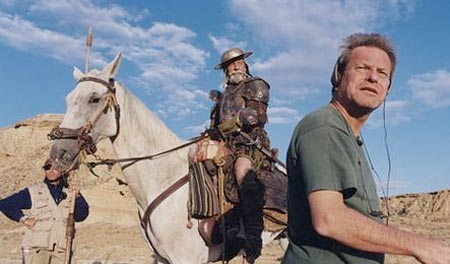
Lost in La Mancha documents Terry Gilliam's attempt to produce a finished verison of 'The Man Who killed Don Quixote'. It captures Gilliam's ambition to see the project through and how it spirals out of control as more and more obstacles block Gilliam from achieving this. "Lost in La Mancha gives the viewer a unique insight into the way in which films are made and unmade, a glimpse at the peculiar fragility of filmmaking as an art form, and a potrait of the insainty and nobility of creative spirit." (Smart, 2002) This evidence outlines the experience Gilliam had with this project and how his passion pushed him forward even though the production was riddled with problems such as a severe storm the destroys and washes away some of the equipment. Through the documeted journey, the viewer sees Gilliam overcome most of the problems as he tries to ignite the filming process after each failure but eventually Gilliam becomes defeated due to one of the bankers not having all the money promised.


Figure 1, (2009), Jean Rochefort (Quixode) riding a horse Scene

Gilliam was not the only director to the fail the 'Quixote project' as several more failed attempts have been made previously. "...the history of cinema is marked by the bleached bones of unmade or unfinished versions of Don Quixote, stretching from Sergi Eisenstein's in the 1920's to Orson Welle's in the 1950's. It's as if some curse were transfered from it's mad, idealsitic hero to those attracted to bringing him to the screen." (French, 2002) The viewer can experience this 'Quixote Curse' as Gilliam was continuously pushed back from storms and sounds of an aeroplane overhead as if a mystic force was telling the director that this film was never meant to be made. There is also a connection with Gilliam and the previous directors on this project such as Orson welles who struggled on the project for two decades before his star of the film died before the project was finished.


 Figure 2, (2003), Still of the actors walking through the desert scene

The documentary also links Gilliam to his star in the film, when the project seems hopeless. "Fulton and Pepe are brilliant filmakers in their own right, framing Gilliam trudging lost across a mud flat like the manifestation of his demented hero..." (Chaw, 2002) In the evidence 'the manifestation of his demented hero' the quote identifies how Gilliam had to cover strenches of vast open desert to work on a new shot but also his a link to his main star Quixode, both setting out on an endless journey that seems unlikely to ever finish. Gilliam changes emotionally, shown in the documentary as promises of excitment to the final scenes depicting his disappointment and self failure.


 Figure 3, (2009), Terry Gilliam expressing how his ambition has failed


Illustration List

Figure 1, (2009), Jean Rochefort (Quixode) riding a horse Scene, @ http://www.iwatchstuff.com/2009/05/here-comes-a-lost-in-la-mancha.php, Accessed on: 15th May 2009


Figure 2, (2003), Still of the actors walking through the desert scene, @ http://thecia.com.au/reviews/l/lost-in-la-mancha.shtml, Accessed on: 3rd July 2003

Figure 3, (2009), Terry Gilliam expressing how his ambition has failed, @ http://fearfulsymmetryuk.wordpress.com/2009/06/28/tideland-and-lost-in-la-mancha/, Accessed on: 28th June 2009

Bibliography

Chaw Walter, (2002), Lost in Mancha, ½ out of 4, @ http://filmfreakcentral.net/screenreviews/lostinlamancha.htm, Accessed on: 14th October 2002

French Phillip, (2002), Down the Shoot - Lost in La Mancha, @ http://www.guardian.co.uk/film/2002/aug/04/philipfrench, Accessed on: 4th August 2002

Smart, (2002), Smart - Lost in La Mancha,@ http://www.smart.co.uk/lostinlamancha/lm_story.htm, Accessed on: 2002

1 ½ /5