Showing posts with label Year 1 Environment Movie Reviews. Show all posts

Thursday, 20 January 2011

Blue Velvet Directed by David Lynch


This characters of Jeffrey and Frank are closely linked within the themes of surreal and dark because there are subtle links between them, the obvious is the fascination with Dorothy. Frank is the typical villian holding a member of the family hostage and raping the woman he is black mailing but the character also had a breathing disability which showed a sign of humanity. Frank was a mainly a character to be feared because even with the disability, there was presence and power when he entered the apartment scene and started to force Dorothy to satisfy his desires. There were hints that Frank might have been insaine, one example is when he is appling lipstick and kisses Jeffrey, which seemed to indicate that the character was a metaphoric monster as he was not afraid to unleash his dark identity on the other characters.  Jeffrey is a detective but his job is put into question when he is found hiding in the closet of Dorothy's apartment, which looked like he was a pervert. This means that the most honourable men could be twisted within the dark mean changing the perception of what there intentions are.  Sandy discovered that Jeffrey was close with Dorothy and her perception of what kind of person he is changed, symbolising something dark that was conceallled has now been revealed into the open. 'some ways, the two male leads represent the two dichotomous sides of life (e.g., light/dark, normalcy/aberration, attraction/repulsion, innocence/expriences, perversion/love, virtue/base desires, etc.) that struggle for dominance' (Dirks, 2010), the quote explains how the line between opposites are crossed so that a particular scene could have a hidden dark meaning.


Figure 1, 2010, Frank blackmailing Dorothy

There was a sense of eerieness in the sets because there were two time periods merged together. The houses were nineteen sixies but apartment set was designed as it would of looked in the eighties, this clash created a fantasy America with conflicting themes. Lynch is famous for making his films dark and twisted but this film was a lot more subtle because real themes were slightly bent to fit the theme of the story. 'And so begins Blue Velvet, an abrasive, original look at violent and perverted behaviour that could have only come from the mind of David Lynch' (French,2001), this evidence implies that Lynch focusses on the dark perception on very basic real themes and that he creates a fantasy world around this to create disturbing and uncomfortable tension. An example is violence because a lot of films would usuallly show the excitment and the thrill that comes from the adreline but this film  focussed on capturing the horror and evil that it really is. The closet where Jeffrey hides to spy on Dorothy has a great cropped view so that he could only see a sliver of the space. Also the use of little light pouring through the slits on the door really made the space feel small and claustrophobic. The scene where Dorothy is left naked on the lawn has a simliar appearance to a Gregory Credson photograph because it was at night and if the purpose was not known, it could create a lot of meanings around the themes of abandonment and protestution.


Figure 2, 2011, Jeffrey hiding in closet


Figure 3, 2007, Dorothy's apartment

The song 'Blue Velvet seemed to a flowing connection throughout because it was the only song Dorothy would sing in the bar as if their was some personal connection. The song also effected Frank emotionally because in one scene he is crying so this could mean he had a deep connection with the song or a syptom of his insainty that relaxes him. Even the soundtrack would play the song Blue Velvet at the points in the film where Jeffrey and Dorothy were making love or kissing. The rest of the soundtrack was strong keeping to the rules of the two separate rules of the two eras. The songs for the sixties city was calm and represented everyday life but the track for the apartment scenes built up tension and typical for an eerie space.
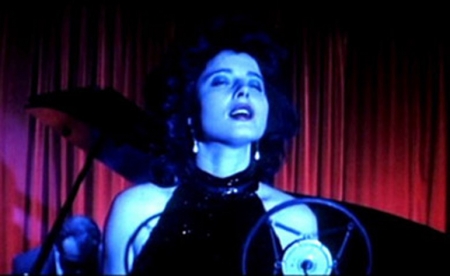

Figure 4, 2010, Dorothy singing

The ending was disturbing because it was perfectly tied up and 'they all lived happy after' scenerio, which is not expected in a Lynch film. It was depicted as if the experience hasn't effected either Jeffrey or Sandy, especially considering some of his hidden secrets with his dealings with Dorothy but they seem oblivious to this. However when all the characters stop to stare at a bird perched outside the window, it looks like it is made from clock work, identifying that this perfect world could be another fake creation. It also indicates that this world has the potiential of turning dark and falling into a twisted surreal dream. 'The time period is unsettled. It more or less seems to be taking place in the present day, but it mashes together elements from several eras.' (Hanke 2010), Hanke sums up how the themes could appear confusing to a viewer in Lynch' s clever twisted style and therefore implies how this ending has alot of hidden dark elements that have not quite revealed themselves in the open.

Illustrations

Figure 1, Visible Justin, (2010), Frank blackmailing Dorothy, @ http://mubi.com/topics/12795, Accessed on: 30th June 2010

Figure 2, Richards Deke, (2011), Jeffrey hiding in closet,@ http://www.posterpalace.com/categorysearch.lasso?-Token.category=mystery, Accessed on: 2011

Figure 3, Day Borris, (2007), Dorothy's apartment, @ http://www.flickr.com/photos/19971779@N00/358808656, Accessed on: 15th January 2007

Figure 4, Parks Matthew, (2010), Dorothy singing, @ http://mubi.com/topics/12795, Accessed on: 2008

Bibliography

Dirks Tim, (2010), Film site, @ http://www.filmsite.org/blue.html, Accessed on: 1st January 2000

French Blake, (2001), Filmcrictic.com, @ http://www.filmcritic.com/reviews/1986/blue-velvet/, Accessed on: 25th October 2001

Hanke Ken, (2010), Blue Velvet(R), @ http://www.mountainx.com/movies/review/blue_velvet, Accessed on: 30th June 2010

Wednesday, 12 January 2011

The Shining 1980 directed by Stanley Kubrick


Figure 1, (2011), still of Jack

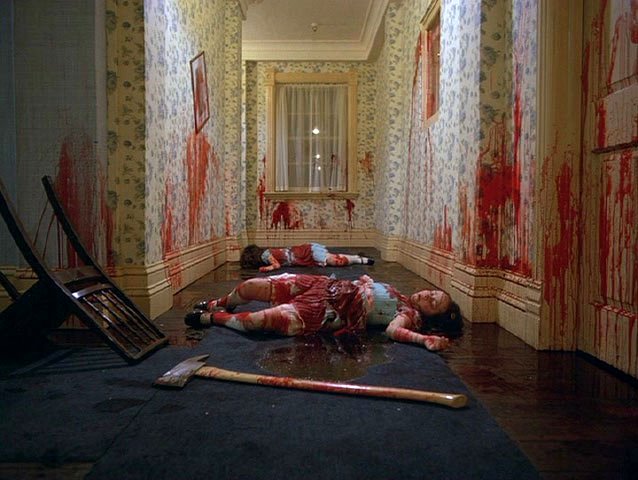
The Shining  centres around Jack Torrance who slowly loses his mind and becomes the identity of the caretaker. The films allows this theme to flow gradually so that the audience have time to get engaged with the links of the Torrence family with the Grady's. The form of imaginative visuals that the whole family could see in the form of mad dellusions was a powerful indicator that there was something eerie about the empty hotel space. The dellusions told the story of the plight of the Gradys and how their situation ended up in murder because of how the husband felt that he should take care of them. The theme is repeated in the Torrance family as this was the correct course of action in Jack's mind. "The movie is not about ghosts but about madness and the energies it sets loose in an isolated situation primed to magnify them" (Ebert, 2007), the evidence identifies the hotel as a small empty prison that echoes the grim past left behind. It also shows how a welcoming space such as the hotel could trigger panic, insanity and therefore can become an unavoidable prison.


Figure 2, (2011), still of murder scene illusion

There was a lot of suggestion to the uncanny used to depict the ghosts/echoes, The twin girls that haunt Danny have a doll - like appearance and dressed identically to indicate the idea of a perfect double. The woman that haunts the room that musn't be opened appears as a beautiful young girl but transforms into a horrible cackling old woman creates the idea that her intent is to deceive men who enter it, Jack discovers the transformation as is kissing the younger version of the woman and is suddenly repulsed by her because she is no longer the familiar young beauty. Mirrors were strong within the film to reveal true characters and their intentions, they suggested a transformation taking place in the character of Jack as the audience could view his creepy expressions in the mirror as if an evil double was slowly surfacing. This theme was also explored in the character of Danny because throughout he had an imaginary friend called 'Tony' and took on two personalities when he was talking suggesting that Danny has two identites conflicted within and that the sweet innocent stereotype has a form of insanity.

Figure 3, (2009), still of Grady sisters

Figure 4, (2011), still of danny

The use of steady cameras to capture the slow errie theme of the film provided the intense build up of something that is evitable such as the scenes where the camera is following Danny in his toy bike along a narrow corridor and leading up to a horrific scene. It also helped to track the vivant sense of a shadow looming into view and the footprints in the snow captured during the maze scene. They created the impression of someone being stalked and hunted because of the luminous white of the snow. "Kubrick's use of space and the eerie steadycam have never been put to better use." (Anderson, 2005), the quote links back to how the steadycams help to make the sets appear more creepy and lead up to something that is about to happen.

There are subtle written clues that hint the direction which the plot is about to take, the red rum warning is one example because Danny keeps repeating these words at different points of the film, while they are staying in the hotel. The audience is completely clueless even when he writes on the door because it is only read as Red Rum, until Wendy sees the message reversed in the reflection of the mirror. The warning is suddenly made clear depicted as Murder just before Jack crashes through with his axe. Another example is the repeated message on the pages from the type writer 'Work and no play makes Jack dull', the idea of this repetition of a sentence strengthens the truth. Wendy realises that her husband has totally been taken control from his insanity, which was further strengthed by her horrific screams and emotion of real fear.


Figure 5, (2011), still of red rum warning

The soundtrack was the strongest element that helped the film to flow and create the tension because it was classic piercing and shrieking sounds to capture the intensity of the points where a scene appears disturbing. The soundtrack was also used to mark the different days and times to instantly impact the fact that the next day of the tale has began but also reforces how the little events build up to the climatic ending. The soundtrack was the obvious tool that outlined that the hotel was actually unhomely and that the family was slowly transforming from a typical household into a disfunctional family with a father intent of harming his wife and child, becoming the psychotic muderer. "...the film has some of the most beatiful, atmospheric cinematography, by John Alcott, I have ever seen. Other technical credits are also superb, including the extremely eerie, memorable instrumental music score by Herbert Von Karajan." (Putman, 1998), the evidence indicates how the soundtrack strengthened the eerie atmosphere of the film because of it's strong connection to the horror theme.


Figure 6, (2011), still of Wendy screaming


Illustrations

Figure 1, (2011), still of Jack, @ http://www.fanpix.net/0676496/011997301/the-shining-1980-picture.html, Accessed on: 2011

Figure 2, (2011), still of murder scene illusion, @ http://moviescrunch.com/the-shining-movie-review-1980/, Accessed on: 7th January 2011

Figure 3, (2009), still of the Grady sisters, @ http://blog.scad.edu/ereber/, Accessed on: 9th February 2009

Figure 4, (2011), still of Danny, @ http://www.fanpix.net/picture-gallery/0676496/the-shining-pictures.html,
Accessed on 2011


Figure 5, (2011), still of red rum warning, @ http://movies.yahoo.com/movie/1800116994/photo/535403, Accessed on: 2011

Figure 6, 2011, still of Wendy screaming, @ http://www.fanpix.net/0676496/011997306/the-shining-1980-picture.html, Accessed on: 2011

Bibliography

Anderson Jeffrey, (2005), Combustible Celluloid, @ http://www.combustiblecelluloid.com/classic/shining.shtml, Accessed on: 6th December 2005

Ebert Roger, (2007), Chicago Sun-Times, @ http://rogerebert.suntimes.com/apps/pbcs.dll/article?AID=/20060618/REVIEWS08/606180302, Accessed on: 8th May 2007

Putman Dustin, (1998), dustin's review - The Shining, @ http://themovieboy.com/reviews/s/80_shining.htm, Accessed on: September 1998


Tuesday, 21 December 2010

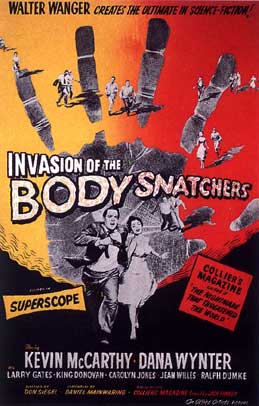
Film influence - Invasion of the Body Snatchers 1956


Directed by: Don Siegel

Miles is introduced in the beginning as dellusional, talking about the strange events that have taken over the town and proclaims this threat would take over the world. At this point the audience don't know what to make of Miles and if he is telling the truth so he narrates his story. The audience first becomes suspicious when a boy and women in the town are certain that some of their relatives are not as they appear because they appear emotionless but there is not much proff as they are identical to person they represent. This was an interesting technique of how Siegal subtly approached the theme of the uncanny because the signs of difference within them were so subtle that the audience try to locate the part which separates the humans and aliens but it is hard at the beginning because they are an almost perfect copy. "A superbly crafted film by innovative director Siegel, this low-budget science fiction tale became one of the great cult classics of the genre." (Drunker, 2007), the evidence explains how the director focussed on the story how successful it is visually due to change of action of emotion when the characters become the pod people.


There is also traces of the tableu - vivant style in the film, one typical example is the discovery of the body in Jack's cellar as there is no clue as to where it came from, why they have taken on the appearance of certain characters or if they are dead or alive. The only clue the audience is given is that some sort of process is slowly taking place as at closer expection the body is not yet complete missing the details of fingerprints, scars, etc. The idea of the person sleeping and waking as the alien clone was also a mystery at first because they still seemed like their normal selves and there wasn't a clear signal to demonstrate any changes. "This tense, offbeat piece of science-fiction is occasionally difficult to follow due to the strangeness of its scientific premise. Action nevertheless is increasingly exciting " (Staff, 2008), the evidence clarifies that the film and themes are wrapped in mystery and therefore takes a while the audience to fully understand what is happening but appreciate this as a typical science fiction movie full of action.


Figure 1, (2008), still of discovery of the body in the basements

As the film progresses it later reveals seed pods from space that form the growing bodies as they are able to take on any life form. Discovering this truth shifted the perception of Uncanniness to horrific fear as a suspense tension of who can Miles trust, can anybody be trusted. Eventually the entire town is converted leaving Miles and Becky as the only two humans left. Towards the end of the film the characters are chased down by the converted humans replacing the idea of humans chasing down the freak into the actual humans have become outcasts because they refused to be replaced/ copied by the pod people, therefore they have become the freaks that are hunted down. There is an excellent breathtaking scene where Miles returns to Becky after discovering the source of the music and she deceives him and the audience into believing that she is still human and didn't fall asleep, however when Miles kisses Becky, he immediately tells the difference and her mannerisms and tone of voice changes to cold and sharp like the rest of the pod people, representing the person Miles loved and the person that was most familiar to him stripped away to leave Miles on his own forever.

 Figure 2, (2010), still of the forming of the pod people


 Figure 3, (2009), still of pod from space


 Figure 4, (2010), still of Miles trying to convince the next town

Miles manages to escape but appears crazy as he frantically tries to find anyone who would believe him and take his warnings of the pod people seriously. The audience is then returned to the opening scene of Miles explaining his story to the doctor that still cant believe the impossible truths of the creatures that have managed to invade a town undetected. Then another character delievers news of an accident with a truck carrying thousands of strange pods heading into town, it becomes evident that Miles was telling the truth and the film leaves off in a mass panic and beginning the resistance of invasion but becomes unclear of what side will truimph."It's still a chilling picture, gaining over Phil Kaufman's smart remake by virtue of it's intimate small town setting, and it has one of the greatest endings ever filmed" (Andrew, 2006), the evidence indicates the slow transformation into the town and atmosphere becoming slowly pocessesed by an evil being taking away emotion and what makes the characters human. Miles has a strong line in the film in response to transformation taking place 'We have to fight to keep hold of humanity because that is what makes us human'.


 Figure 5, (2010), still of clone Becky awakening


  Figure 6, (2010), still of chase


Illustrations

Figure 1, (2008), still of discovery of the body in the basment, @ http://filmsdefrance.com/FDF_Invasion_of_the_Body_Snatchers_1956_rev.html, Accessed on: 2008

Figure 2, (2010), still of the forming of the pod people, @ http://www.dvdbeaver.com/film/DVDReviews24/invasion_of_the_body_snatchers.htm, Accessed on: 2010

Figure 3, (2009), still of pod from space, @ http://www.gadflyonline.com/11-26-01/film-snatchers.html, Accessed on: 1998

Figure 4, (2010), still of miles trying to convince next town, @ http://wearemoviegeeks.com/2010/09/kevin-mccarthy-actor-of-1956-sci-fi-classic-body-snatchers-dead-at-96/, Accessed on: 12th September 2010

Figure 5, (2010), still of clone becky awakening, @ http://www.flickr.com/photos/29235625@N04/2778747162/, Accessed on: 2010

Figure 6, (2010), still of chase, @ http://nighthawknews.wordpress.com/2010/03/18/the-year-in-film-1956/, Accessed on: 18th March 2010

Bibliography

Andrew Geoff, (2006), timeout London, @ http://www.timeout.com/film/reviews/76141/invasion_of_the_body_snatchers.html, Accessed on: 24th June 2006

Drunker Don, (2007), Tv guide - Invasion of the Body Snatchers, @ http://movies.tvguide.com/invasion-body-snatchers/review/102182, Accessed on: 24th June 2006

Staff Variety, (2008), @ http://www.variety.com/review/VE1117792012?refcatid=31, Accessed on: 31st December 1955

Thursday, 16 December 2010

Eraserhead 1976 Directed by David Lynch


The theme throughout the film is dark and surrealism because of how the plot plays on the nightmares and fears people have on relationships and families but Lynch has taken those fears further to create a twisted world that slowly loses all sense of reality. Lynch made the decision of blocking out human dialogue at the start of the film so that the noise of the machinery and the man pulling the levers is the main focus, it is confusing of the purpose of this man at first but could be a symbol of the man pulling the strings controlling the world and people round him. The unnerving soundtrack was effective throughout because it helped to express the tension of some of the most disturbing scenes. It defined those chilling and piercing moments of the dream sequences where the visuals didn't have a clear meaning but seem to fit the idea of Henry Spencer' s delusions morphing into the unknown. "Jack Nance's electro-shock hairdo Henry, whose girl produces the aforementioned baby, now seems funnier in his perpetual puzzlement than he did. But the film retains its essential menace, like a dream you can't leave even if you want to." (Malcolm, 2010), the evidence shows that even though the theme is repulsive and dramatic, the audience can not turn away from it because the film is unlike anything they have experienced or seen.


Figure 1, (2009), eraserhead still of baby head on Henry's body delusion

The meeting of Henry's parents indicates a biazaire scenerio of that akwardness and the uncertainity of meeting new people. The parents and girlfriend seem to suffer from their own delusions as shown in the dinner scene with the mother behaving strangely, making werid noises at the cooked chicken appears to be moving it's legs and the scene where mary rocks the bed back and forth while giving Henry a deathly stare. Lynch also incoporates Polkanski's idea of the creepy neighbours in the form of the wife next door wanting to come in and have sex with him but becomes unhinged at the sight of the premature baby, representing the fears of what tie people down and how a relationship becomes complicated. The next scene where they see eachother, the neighbour envisions the mental scene of the baby's head on henry's body as if she has become disgusted and no longer want's anything to with him. "Father Bill roasts oddly alive minature chickens and with frozen smile exhibits his frozen arm, and cataonic Grandmother smokes while Mother helps her mix the salad and, vampire-kissing him, informs the bashful suitor that mary is prgnant, so they must marry. The non sequiturs and long dining room silences..." (Levitt, 2010), the evidence is worded as if the behaviour of the other characters are seen through the delusions and fears of commitment in a relationship and the responsibilities of Henry's actions towards Mary.

Figure 2, (2010), Eraserhead still of dinner scene

The premature baby was the source of the surreal uncanny because the viewers are told and know that it is a baby, which is clear in it's size and shape but it's appearance is alien and so far removed from what people recognise. There is alot of human essence within the creature through it's use of crys and annoying sounds identifies it immediately as young, vulnerable and utterly dependant on it's parents, so even though Henry Spencer and Mary may be repulsed and disgusted with the creature it's still technically their child and the film demonstrates the pressures of raising it and the stress that can build up in this situation. "In this world, the baby, resembling an overgrown penis, both represents male sexuality and symbolises Henry's own sexuality. Similiar to uncontrollable sexual urges, the baby penis constantly demands attention from Henry who becomes it's slave." (Caldwell,2010), in the quote, Caldwell links the desires and fears of male sexuality which loosely leads into incest and the idea that the child constantly calls for love and attention and the idea of Henry becoming it's slave depicts that love as pocessive. The nighmare of henry's head dropping off and the baby's replacing it also entered the realm of the uncanny and the visions of what appears to be real can suddenly twist and transform into a realm of fantasy played on by the fear.

Figure 3, (2010), Eraserhead still of premature baby


Figure 4, (2009), Eraserhead still of baby dying

The lighting was used to visually express moments that higlight objects or people that haven't quite taken form or happened, this was to allow the audience where next focus would be staged. The bedroom scene also seemed to be purposely dark so that intense spotlight could reveal the baby's position and movements, identifing that it always there as a real being and can not be escaped from in the character's and audience's perspective. The scene towards the end of the film where Henry finally builds the courage to kill the baby triggers a final vision of a huge premature head approaching closer with the aid of flashing lights indicting that it is heading towards henry. This vision could be seen as guilt from the terrible act he has just commited or recurring the nightmare of it's head taking his place suggest that by killing the baby he has allowed his fears and nightmares to accelerate and control him. The end of the film sees Henry on about appears to be a different world/ plain meeting with the mad people of his delusions, whether this means he has found an escape or accepting his tormented fate is unclear because it is suddenly cut off as Lynch decided that he didn't want his viewers discovering what was really happening in the final scene.


 Figure 5, (2010), Eraserhead still of woman delusion


Figure 6, (2010), Eraserhead still of set


Illustrations

Figure 1, (2009), Eraserhead still of baby head on henry's body delusion, @ http://366weirdmovies.com/22-eraserhead-1977, Accessed on: 2nd June 2009

Figure 2, (2010), Eraserhead still of dinner scene, @ http://www.mondo-digital.com/eraserhead.html, Accessed on: 2010

Figure 3, (2010), Eraserhead still of premature baby, @ http://www.sensesofcinema.com/2002/great-directors/lynch/, Accessed on: 21st May 2002

Figure 4, (2009), Eraserhead still of baby dying, @ http://dinca.org/page/24, Accessed on : 9th April 2009

Figure 5, (2010), Eraserhead still of woman delusion, @ http://midnightradio.soup.io/tag/david%20lynch?type=image, Accessed on: 2010

Figure 6, (2010), Eraserhead still of set, @ http://mubi.com/films/196, Accessed on: 2008

Bibliography

Caldwell Thomas, (2010), Senses of Cinema Issue 56 The Evil that Men do - David Lynch, @ http://www.sensesofcinema.com/2002/great-directors/lynch/, Accessed on: 21st May 2002

levitt Donald, (2010), Reel Talk Movie reviews - The Head Horror Picture Show, @ http://www.reeltalkreviews.com/browse/viewitem.asp?type=review&id=2019, Accessed on: 8th Jan 2007

Malcolm Derek, (2010), this is London  - Eraserhead still stands out, @ http://www.thisislondon.co.uk/film/review-23554307-eraserhead-still-stands-out.do, Accessed on: 11th Setember 2008

Thursday, 9 December 2010

Repulsion 1965


 Repulsion (directed by Roman Polanski) is centered around the character of Carol who is left in the house alone after her sister and married boyfriend take a trip. The house is a typical home when all three characters are living there but when Carol finds herself alone in this space, the atmosphere changes as she slowly becomes insaine. The first thing the audience notices in the empty space is the use of sound of the ticking clock, endlessly clicking which symbolises how time appears to be slower and how irratating this object can be in a quite space because you are unable to escape it. Also the noise of the bell from the church opposite, hearing those loud chimes would also drive a person crazy. "Polanski makes astonishing use of sight and sound to evoke claustrophobic insanity. He also orchestrates some brilliant practical effects, one (involving the set) enabling one of the great "jumps" in horror cinema." (Canavasse, 2009), the evidence implies that Polanski has directed how the space feels smaller and because of the intense quietness the character has to endure the dull metalic sounds that surround people all the time which usually goes unnoticed because of the busy populated areas. The effects symbolise the attention a person would give when they are alone how the mind would cope with all these endless sights and sounds.

Figure 1, 2009, Repulsion still

Men are seen in a bad light in this film as beasts only after women for sex, along the similiar themes of Rosemary's Baby seen as dark and possessive. Carol had an unfortunate experience in her childhood as the evidence of the visions of the man raping her and the photograph of the weak, innocent girl with the two men ignoring suggests she had a terrible childhood of being sexually and physically abused. This conveys the dark twisted theme of insest, which Carol carries with her like a forbidden secret but gives meaning as to why she is afraid of getting close to a man but in the empty space visions of her past come back to haunt her and she can't think of any thing else because Carol still fears her past and does whatever necessary to ensure that she doesn't encounter a similiar situation. The character of Carol can also be compared to Barbaraella as both are young beautiful innocent women that are seen as an object through the eyes of the men trying to seduce them.

The environment changes as Carol evokes more mad dellusions showing the walls and ground cracking when a light is switched on or a piece of furniture is moved. At the end of the film the house interior has completely transformed into a ruin slowly decaying away and objects broken and cluttered. Carol also envisons hands appearing and trying to grope and snatch her, this connects to the idea of Hades Underworld in greek mythology of the lost souls in River Synx trying to pull mortals in to join them and this is the impression in the film that the hands are snatching from reality into her dark past of nightmares. The cracks that appear could be seen as something/ or someone trying to get as Carol envisions the father or brother that abused her to enter her space of thought. Also they demonstrate how Carol's mind is slowly deteriorating and allowing her memories to control and scare her from leaving the house and letting people in. "... the apartment, shabby in the first place, becomes a shambles, a junkyard with leftover food, objects lying on the floor, and so on. Gradually, Carol's physical and social isolation in a confined apartment escalate to the point of no escape, unleashing her built up panic and terror with acts of violence." (Levy, 2008), the evidence explains how the once familiar home has turned against Carol and become a prison and shut off from real life has caused her subconcious to run wild with imagination to create fear and doubt within the character.

Figure 2, 1996 - 2012, Repulsion still


Figure 3, 1996 - 2012, Repulsion still

The neighbours are once again displayed in Polanski's vision, taking them away from the kind familiar image into a group of people leering and interfering with the affairs of the main character. A good example is the landlord because he begins to enter the space and demand the payment he is owned and then takes pity and sees the condition Carol is living in and lingers in the space to offer his opinion on how it is unhelpful to live alone, then there is a beast-like transformation that takes hold and tries to seduce her because she is young and vulnerable, which conjures the destressing memories of her sexual abuse and takes action by killing him. Also at the end of the film the neighbours in other apartments flood in and crowd round in the bedroom to examine the collapsed Carol and find out what happened, their positions seem to look like they are cornering her in a space no longer giving her privacy.

Figure 4, (2007 - 2010), Repulsion still

The film has a slow pace so that the audience can appreciate and really look at the scenes and see what situation mite happen but needs to play out to understand why Carol is about to kill the character with the object in her hand. The idea of killing because of the sexual feelings has also been used in Cat People and the idea of a dark beast taking hold as a pleasurable fantasy but Repulsion shows this through the eyes of a twisted killer showing no emotion as strikes her victims down with a candle stick or shaver. The soundtrack used in the film also helps to keep the pace of the film because the points where the music changes into the most grotesque sounds reminds the audience that Polkaski chose it for a reason as unescapable terrority for the insanity to take hold and be understood in the dire situations of the film. "An oppressive silence is broken only by the buzzing of flies, dripping water, a ticking clock. Rooms change shape, the mere flip of a light switch creates fissures in the walls, a phantom ravisher begins to stalk the tiny flat." (Time Magazine, 2008), this quote reminds the fact of the surreal elements within the space added with the piercing chords in the soundtrack successfully demonstrates the constant shifts and changes in Carol's mind and the once familiar space.


Figure 5, 2007 - 2010, Repulsion still

Illustrations

Figure 1, (2009), Fanpix.net Repulsion still, @ http://www.fanpix.net/photos/0663081/repulsion-picture-gallery-2.html, Accessed on: 2009

Figure 2, (1996-2012), pHinn web Repulsion still, @ http://www.phinnweb.org/links/cinema/directors/polanski/repulsion/, Accessed on: 1996

Figure 3, (1996-2012), pHinn web Repulsion still, @ http://www.phinnweb.org/links/cinema/directors/polanski/repulsion/, Accessed on: 1996

Figure 4, (2007-2010), myReviewer.com Repulsion still, @ http://www.myreviewer.com/RepulsionDigitallyRemasteredEditionDVDDetails/a129832, Accessed on: 1999

Figure 5, (2007-2010), myReviewer.com Repulsion still, @ http://www.myreviewer.com/RepulsionDigitallyRemasteredEditionDVDDetails/a129832, Accessed on: 1999

Bibliography
Canavasse Peter, (2009), Groucho reviews Repulsion, @ http://www.grouchoreviews.com/reviews/3489, Accessed on: 28th July 2009

Levy Emanuel, (2008), Emanuel Levy cinema 24/7 Repulsion, @ http://emanuellevy.com/search/details.cfm?id=13896, Accessed on: 25th July 2009

Time magazine, (2008), Cinema: a Maiden Berserk, @ http://www.time.com/time/magazine/article/0,9171,842218,00.html, Accessed on: 19th October 2008


The Tenant 1976


This is Tenant directed by Roman Polanski and also stars as the main role as Trelkovsky who moves into a flat where the previous tenant has recently commited sucicide so already at the start of the film there is the tension of the atmosphere where strange things has happened. After Trelkovsky has settled into the flat there is an immediate disagreement from the neighbours that seem to single him out to complain about noises they hear at an impropiate time of the morning. "... but that his life was famously one of nearly-constant references to Trelkovsky's alien status, even as he feebly protests that he is a French citizen, are surely resonant with Polanski's well-documented feelings as an exotic outsider in the Hollowood community." (Brayton, 2005 - 2010), the evidence shows that Polanski has used references of his traumatic past for the disturbing themes for his films especially in this film as he is Polish and doesn't fit into society because he is not a true French citizen so could never belong amoungst the people.


Figure 1,Vage Bond, (2007), The Tenant still 

There is strong use of tableu vivant style used in the scenes where Trelkovsky spies on the flat opposite and the people are frozen and suspended in time creating a perfect freeze frame which leaves the audience totally confused as to what is happening as there are no clues or suggestions to inform the intentions of the frozen characters. As the film progresses Polanski is in the opposite flat and looks over at himself peering through the overside with binoculars which could be seen as his future and past colliding into one scene. Evidence of this theory is shown at the end of the film where it seems to loop back round to the start where Trelkovsky and Stella visit the dying Simone in hospital wrapped in bandages but seen in the point of view of the bandaged victim which is Trelkovsky rushed to hospital after trying to commit sucicide. This scene questions if there was a 'Simone' in the first place or an invented character in Trelkovsky's subconcious due to his mad delusions, also the use of his past and future self used in one space.

Figure 2,Vage Bond, (2007), The Tenant still 

Trelkovsky begins to have dellusions that pressures him to slowly become Simone, this starts subtly with him choosing Simone's favourite chair and cigarettes in the restaurant to buying wigs, shoes and outfit to crossdress as this person. He believes it is the unfriendly neighbours that are inspiring these changes to follow the footsteps of Simone and kill himself as Trelkovsky infurates them with the way he behaves in his lifestyle and the fact that he wouldn't sign the petition to evict another neighbour they have conspired to be against. Towards the end of the film, Trelkovsky can't trust anyone including Stella who he could tell everything to which pushes the character over the edge. “Although overshadowed by director Roman Ploanski's  more famous horror efforts, REPULSION and ROSEMARY’S BABY, the more obscure THE TENANT is actually their equal and in many ways their superior — a haunting, mesmerizing tale of a man’s loss of identity and descent into madness.” (Biodroski, 2010), the evidence reveals that Polanski's aim of this film was to create the scenero of a character that has been totally been cut off from real life and people who were once trusted friends and because of this the subconcious has found an escape through the dellusions to haunt the characters of 'Simone' and what they susposedly drove her to do. 

 Figure 3,Vage Bond, (2007), The Tenant still 


 Figure 4,Vage Bond, (2007), The Tenant still 

The neighbours are seen in a dark light in Polanski's films to change the image of the familiar friendly people that live close by and rely on into a set of people that have a need to interfere and inflict their opinions of how certain things should be within society and how people should behave. The theme is strongly used in this particular film because the moment Trelkovsky steps into the building, the neighbours hound on the type of figure he is (a bachelor) and how they don't what him to behave in this manner. After the reasonable complaints of 'the music is too loud', the neighbours seemed to be obsessed with finding a reason to complain when in some cases Trelkovsky can't really be blamed as he wasn't in his room or succumbed to his insaine dellusions and not in the right frame of mind to act naturally. "A disturbing and poignant anthology of Roman Polanski's favourite, oppressive themes." (Newman, 2010), the evidence proclaims that Polanski uses these themes in many of his films because they don't imply horror in the usual way but instead a subtle approach of how the whole atmosphere changes due to the frame of mind of the character who becomes obsessed of the other characters using them and drive them to the point of insanity because it is the only alternative for the subconcious to deal with the situation, the audience experiences this turn of reality to insaine dream - like state as the film slowly plays out with small subtle changes to the extreme measures the character takes. Through the dellusions the characters apparantly involved in the conspiracy seem to be mocking and pointing up at him, waiting for Trelkovsky to jump, after the first attempt the neighbours are woken and gather round him. In Trelkovsky's mind, the neighbours are shown to be cornering and trying to capture him as if he was a wild animal or a freak due to the way he is dressed.

Figure 5,Vage Bond, (2007), The Tenant still 


Figure 6,Vage Bond, (2007), The Tenant still 


Figure 7,Vage Bond, (2007), The Tenant still 


Illustrations

Figure 1, Vage Bond, (2007), The Tenant (Le Locataire) (1976), @ http://www.moviescreenshots.blogspot.com/2007/07/tennant-le-locataire-1976.html, Accessed on: 25th July

Figure 2, Vage Bond, (2007), The Tenant (Le Locataire) (1976), @ http://www.moviescreenshots.blogspot.com/2007/07/tennant-le-locataire-1976.html, Accessed on: 25th July
  
Figure 3, Vage Bond, (2007), The Tenant (Le Locataire) (1976), @ http://www.moviescreenshots.blogspot.com/2007/07/tennant-le-locataire-1976.html, Accessed on: 25th July

Figure 4, Vage Bond, (2007), The Tenant (Le Locataire) (1976), @ http://www.moviescreenshots.blogspot.com/2007/07/tennant-le-locataire-1976.html, Accessed on: 25th July

Figure 5, Vage Bond, (2007), The Tenant (Le Locataire) (1976), @ http://www.moviescreenshots.blogspot.com/2007/07/tennant-le-locataire-1976.html, Accessed on: 25th July

Figure 6, Vage Bond, (2007), The Tenant (Le Locataire) (1976), @ http://www.moviescreenshots.blogspot.com/2007/07/tennant-le-locataire-1976.html, Accessed on: 25th July

Figure 7, Vage Bond, (2007), The Tenant (Le Locataire) (1976), @ http://www.moviescreenshots.blogspot.com/2007/07/tennant-le-locataire-1976.html, Accessed on: 25th July

Bibliography

Biodroski Steve, (2010), Cinefantastique The Tenant, @ http://cinefantastiqueonline.com/2009/12/the-tenant-1976/, Accessed on: 11th December 2009

Brayton Tim, (2005-2010), The Official Charity of Antagony & Ectasy, Apartment House Fools, @ http://antagonie.blogspot.com/2007/05/apartment-house-fools.html, Accessed on: 06th May 2007

Newman Kim, (2010), Empire reviews, @ http://www.empireonline.com/reviews/reviewcomplete.asp?FID=134979, Accessed on: 18th February 2010

Wednesday, 8 December 2010

Rosemary's baby 1968


This is Rosemary's Baby directed by Roman Polanski and there are many twists and turns to keep the audience guessing throughout the film. It begins with the characters Rosemary and Guy Woodhouse moving into a new home which is abandoned and empty, they begin talking about how they are going to make their mark in this space by making in love on the bare empty floor and how they intend to make it homely.  Over the next shot of scenes the space is transformed into a typical American home and once again feels lived in. However there are subtle hints that this is not the happy family home it appears to be because of the neighbours that live close by keep interfering in all the Woodhouse's concerns and although at first this is seen as a friendly gesture, Rosemary eventually finds this as a hindrance on her own free will and how she would rather deal with her pregnancy.

 At the end of the film a hidden room is discovered for the meeting of the coven and the space becomes unfamiliar because it becomes a places of hidden secrets and meanings, destroying the image of the happy home.  "Polanski's greatest strength in this film is his subtlety; his pacing and sense of mood are masterful without calling attention to themselves, letting the horror of the premise sink it's claws in so slowly and quietly that you don't notice how far deep they've gone until it's too late." (Star Plus, 2010), the evidence proclaims how the mood of the film shifts subtly to suggest how the home and characters are familiar to begin with but the atmosphere changes to create the idea of a secret coven and black magic but the audience doesn't piece all the themes together until the end.

Figure 1, Bodsworth Richard, (2010), Rosemary's Baby still


Figure 2, Rosenberg Adam, (2010), Rosemary's Baby still

The theme of feminist sexism is expressed through the film in Rosemary's dreams/ nightmares as they dipict horrific scenes of the characters displaying her nakedness for their rituals and the idea of woman as an object, the theme runs very closely to Barbarella but turns away from the innocent naive approach and embraces the dark possessive side of seduction. When Rosemary regains conciousness, she finds scratch marks running down her back indicating the husband's desires to have her in any condition to please him. The film reveals that the baby is the son of the devil and that Rosemary was selected, it conjures the idea of a strong evil beast seducing a helpless human woman as a form of male erotic fantasy. This theme is what makes the audience realise that Rosemary symbolises an object for sex and to carry the next generation of sin and evil. "Superbly acted (especially by bone-thin Farrow and Ruth Gordon as the ultimate neighbour from hell), it's a satantango in the land of Is-this-real-or-am-I-crazy?, with a luridly literal ending that doesn't negate the previous, more interior terrors." (Park, 2010), the evidence clarifies that the dreams and real world intertwine, which at first causes doubt and suspition on Rosemary's mind and if all the ill treament from the other characters was what she believed but it later becomes clear that they were using her as if she were a weak minded child that wouldn,t understand their aims.


Figure 3, Movie berry, (2009 - 2010), Rosemary's Baby still

There is a division between Rosemary and the other characters because they undermine her actions and thoughts, this becomes clearer as the plot develops and Rosemary becomes obsessed with witchcraft and links the behaviour of the characters within it as a plot to get her baby. Rosemary's obsession with black magic and witchcraft makes her more isolated as the characters begin to question her state of mind and cover their secret by confining her to a room and treat her as if she were crazy. Rosemary also talks to herself of escaping her situation and discover what more of the clues mean to demonstrate more of that passion of the obsession that she cant ignore and acts on these thoughts by trying to run away and eventually finding the hidden lair of the coven. Her obsession is seen as a mental breakdown because she becomes paranoid and unable to trust anybody, however at the end of the film Rosemary seems to float back to the position of mother as she was dreaming of becoming and accepts the hidden evil to keep the child she deparately wants.
 "... there is no violence in the film other than the growing mental torment inflicted on poor Rosemary (by herself?) as she becomes increasingly suspicious of everyone around her... Polanski's most startling accomplishment is ultimately twisting something as natural as maternal instinct into something horrifying, if not downright monstrous." (Dequina, 2006), the evidence indicates that Rosemary's obsessiveness and her drive to be proven right gradually changes the mood of the scenes as the audience begins to understand that the images of her subconcious have appeared in true form as her nightmares have been made real.
Figure 4, Poly Arcos, (2010), Rosemary's Baby still


Illustrations
Figure 1, Bodsworth Richard, (2010), @ http://liveforfilms.wordpress.com/2010/02/16/real-life-film-curses/ , Accessed on: 16th February 2010
Figure 2, Rosenberg Adam, (2010), @ http://www.ugo.com/movies/nightmare-neighbors-nightmare-neighbors-rosemarys-baby, Accessed on: 2nd September 2008
Figure 3, Movie berry,(2009-2010), @ http://www.movieberry.com/rosemary_s_baby/, Accessed on: 2009

Figure 4, Poly Arcos, (2010), @ http://www.meetup.com/VegasArthouse/calender/10060648/?eventId+10060648&action+detail, Accessed on: 29th March 2009

Bibliography
Dequina Michael, (2006),  The Movie Report archive, @ http://mrbrownmovies.com/movierpt77.html#rosemary, Accessed on: 3rd November 2000
Park Ed, (2010), Somebody's watching me, @ http://www.villagevoice.com/2002-08-20/film/somebody-s-watching-me/1, Accessed on: 20th August 2002
Starplus, (2010), Rosemary's baby, @  http://www.starpulse.com/Movies/Rosemary%27s_Baby, Accessed on: 1999