This is the original plan that I showed to Tracey but there was too much information and I needed to twick the beginning and change one of the quotes.
Essay Structure - Ray en
This is my Current Essay Plan after the changes made from Tracey's guidance and is much simplier to read and flows better with corrections.
Essay Structure 2 - Ray en

Thursday, 31 March 2011

The Animation Timeline - Bill Plympton (1946 - Present)


Figure 1, (2008), How to Kiss

Figure 2, (2009), The Tune
Bill Plympton began his cartooning career by creating cartoons for publications such as the New York Times and Playboy. He then went on to produce his first feature films in the style of surreal musical fantasy with inspired animation. "It's quintessential Plympton in that it has a hand-drawn look that emphasizes pencil lines and shading, and it offers up somewhat disturbing absurdest humour that relies on the extreme plasticity of form that only animation can deliver. Plympton is an animator's animator not only because his drawings are magnificent (and magnificently weird), but because he plays the medium for all that it is worth-Plympton's odd and hilarious vision of reality can only be expressed via animation." (Mancini, 2009) Plympton's technique allows a controlled form of how the characters can be exaggerated as if the have a clay feel, able to be morphed and merged to produce disgusting and disturbing forms.

Figure 3, (2011), The Tune 2
Plympton has expressed dark humour in his animations allowing him to exaggerate on serious themes and turn them into something twisted. "Plymptons, dating back to the physiognomy transmutations of 1987's "Your Face", "have always relied on sudden eruptions of sex and violence to elicit audience response." (Staff, 2008) the evidence states how Plympton has taken issues that a viewer would probably find serious in the real world and tend to avoid but in the animations it is appropriate because of the style and light heartiness of the performance. The exaggerations gives the viewer an idea of the emotions that Plymptoon was trying to communicate as in 'The Tune' that reveals two characters separated with the man's successful to write a new hit and become successful and in the process meets a range of unusual characters that have some back story of how they have ended up or where they see themselves going which inspires the main character to see the world different and causes the audience to sympathize with him. "Plympton goes for mood over sight gags, which gives his fans an idea of his range. As an '80's time capsule, the live action portions of the video itself are absurdly amusing." (Lineberger, 2006) The quote picks up on 'mood over sight gags' so basically Plymptoon tries to draw his comedy from emotion and how we hear and feel instead of the obvious.

Figure 4, (2007), Guard Dog
Figure 1, (2008), How to Kiss, @ http://www.plymptoons.com/biography/anishorts.html, Accessed on: 2003
Figure 2, (2009), The Tune,@ http://www.taringa.net/posts/tv-peliculas-series/2003996/The-Tune---Bill-Plympton.html, Accessed on: 13th January 2009
Figure 3, (2011), The Tune 2, @ http://hotfileserve.com/tune-extras-1992-dvd5-641745/, Accessed on: February 2011
Figure 4, (2007), Guard Dog, @ http://www.body-pixel.com/2009/07/22/pocket-cinema-bill-plympton-short-films/, Accessed on: 22nd July 2009
Bibliography
Lineberger Rob, (2006), DVD Verdict - Plymptoons, @ http://www.dvdverdict.com/reviews/earlyplympton.php, Acessed on 28th April 2008
Mancini Dan, (2009), Bill Plymptoon's Dog days, @ http://www.dvdverdict.com/reviews/dogdays.php, Accessed on: 23rd July 2009
Staff Variety, (2008), Film Reviews - Idoits and Angels,@
http://www.variety.com/review/VE1117937044?refcatid=31, Accessed on: 6th May 2008
Wednesday, 30 March 2011
Life Drawing week 24
 |
| Nacoleptic, Aristacratic, Aboilant, Manical, Fertiveness and Melchony |
 |
| Demonic |
 |
| Angelic |
 |
| Angry |
Tuesday, 29 March 2011
Notes from Stop Motion Passion, Process and Performance by Barry Purves
Purves Barry, 2008, Stop motion Passion, Process and Performance, Oxford, Focal Press
5. Getting Personal
- dinosaurs - idea of them being inanimate objects that animators have to create illusion of life - relates to Harryhausen's fantasy creatures
O Brien's attempt at Lost World impressive movement but little account of mass and scale of the creatures betray them as minatures
- the take of a huge creature flicking their long necks and tails from side to side in a few frames doesn't feel believable
- during the age of O Brien, Harryhausen and Danforth used stop motion to animate non exisiting creatures as far as they could be taken
- mix of stop motion and live action not very popular anymore so public expects a stopmotion world as in The Nightmare Before Christmas or Wallace and Grommit
- animators sometimes had to ignore facts and create the credible, not the real as MC Cooper did in King Kong giving the impression that dinosaurs could roar with a range of vocal chords
- "... but bringing Talos to life thorugh stopmotion is so appropiate. Today, a sophisticated CG model might convey the scale better and fit him into the environment more seamlessly, but I doubt that CG would have given Talos the quirky =, ponderous movements that define him one of the greatest animation characters." (Purves, 2008: 63) how stop motion is outdated but also successful
- music sequences helped Harryhausen's scenes breathe life perfectly complementing the animation e.g. skeleton fight in Jason and the Argonaughts used rattles and Cacophony alongside movemnts of stillness and tension
- stop motion creates impression that material is alive changing shape as demonstrated in Morph
8. Different Techniques
Puppets
- "Most of us enjoy stop motion because we like touching something, but there are many different techniques, each one affecting the narrative and how you film." (Purves, 2008: 131)
- puppets - performers already crafted so just manipulated them
- the animators skill is excluded and reduced to mechanical
- puppets don't allow animators to feel the movement
- just an element of the puppet works better as in Creature Comforts and James and the Giant Peach that includes a mouth or whole face that is replaceble bu other pieces
Cross - Over Techniques
- model and 2D animation combined
- e.g. Joan Gratz uses clay and combines this with paintings for extra texture, shadow and movement
- only 2D images survive as 3D models are continuely manipulated so not much life by end of shoot
Cut - Outs
- another technique that allows different forms of animation to merge together
- one example is Lotte Reinger who cuts out black paper to form silhouttes against a bright b/g
- gives uniqueness and depth as they act as table top puppets that can move around in the space more freely
Sand
- sand or salt needs precision
- animators don't get the same sensation as touching or moulding a material as they push it round with a brush
- placed on translucent screens and lit underneath, creating a silhoutted texture
Claymation - clay and plasticine
- need skills of animating and sculpting
- models manipulated into a number of poses to get the shots
- distorting a clay motion puppet through strentch and squash for over emphasisng facial expressions and physical form
- mostly shot on 2 frames per second
- sometimes single frames work if appropiate to let a movement flow better
- examples are Brother's Quy and Jan Svankmajer that animate things that disturb and mix different techniques trying to really emphasize the character
5. Getting Personal
- dinosaurs - idea of them being inanimate objects that animators have to create illusion of life - relates to Harryhausen's fantasy creatures
O Brien's attempt at Lost World impressive movement but little account of mass and scale of the creatures betray them as minatures
- the take of a huge creature flicking their long necks and tails from side to side in a few frames doesn't feel believable
- during the age of O Brien, Harryhausen and Danforth used stop motion to animate non exisiting creatures as far as they could be taken
- mix of stop motion and live action not very popular anymore so public expects a stopmotion world as in The Nightmare Before Christmas or Wallace and Grommit
- animators sometimes had to ignore facts and create the credible, not the real as MC Cooper did in King Kong giving the impression that dinosaurs could roar with a range of vocal chords
- "... but bringing Talos to life thorugh stopmotion is so appropiate. Today, a sophisticated CG model might convey the scale better and fit him into the environment more seamlessly, but I doubt that CG would have given Talos the quirky =, ponderous movements that define him one of the greatest animation characters." (Purves, 2008: 63) how stop motion is outdated but also successful
- music sequences helped Harryhausen's scenes breathe life perfectly complementing the animation e.g. skeleton fight in Jason and the Argonaughts used rattles and Cacophony alongside movemnts of stillness and tension
- stop motion creates impression that material is alive changing shape as demonstrated in Morph
8. Different Techniques
Puppets
- "Most of us enjoy stop motion because we like touching something, but there are many different techniques, each one affecting the narrative and how you film." (Purves, 2008: 131)
- puppets - performers already crafted so just manipulated them
- the animators skill is excluded and reduced to mechanical
- puppets don't allow animators to feel the movement
- just an element of the puppet works better as in Creature Comforts and James and the Giant Peach that includes a mouth or whole face that is replaceble bu other pieces
Cross - Over Techniques
- model and 2D animation combined
- e.g. Joan Gratz uses clay and combines this with paintings for extra texture, shadow and movement
- only 2D images survive as 3D models are continuely manipulated so not much life by end of shoot
Cut - Outs
- another technique that allows different forms of animation to merge together
- one example is Lotte Reinger who cuts out black paper to form silhouttes against a bright b/g
- gives uniqueness and depth as they act as table top puppets that can move around in the space more freely
Sand
- sand or salt needs precision
- animators don't get the same sensation as touching or moulding a material as they push it round with a brush
- placed on translucent screens and lit underneath, creating a silhoutted texture
Claymation - clay and plasticine
- need skills of animating and sculpting
- models manipulated into a number of poses to get the shots
- distorting a clay motion puppet through strentch and squash for over emphasisng facial expressions and physical form
- mostly shot on 2 frames per second
- sometimes single frames work if appropiate to let a movement flow better
- examples are Brother's Quy and Jan Svankmajer that animate things that disturb and mix different techniques trying to really emphasize the character
Notes from Ray Harryhausen An Animated Life by Ray Harryhausen and Tony Dalton
Dalton Tony and Harryhausen Ray, 2003, Ray Harryhausen An Animated life, Great Britain, Aurum Press LTD
1. Discovery of a Giant Ape
- Young built three dimensional objects including prehistoric dioramas - clay saurians provided b/g to realise Ray's dreams when older
- Pg 18 Ray's early example of stop motion and model making
- "It was a Cooper/ Schoedsack adventure that was to be the inspiration for my life - the one and only King Kong (1933)" (Harryhausen, 2003: 17)
- he collected everything he could on King Kong and realised was filmed by means of special techniques
- "Once I realised this, it became the most important thing in my life to discover the true secrets of King Kong." (Harryhausen, 2003: 18)
- he met people who worked on production and told him of stop motion how the process was done
- read magazines that made process clearer - ball and socket joints, glass paintings, scaled down scenery and props
2. Another Ape and a Beast
- Obie befriended Ray during and after war and told him of new gorilla flick Mighty Joe Young and wanted him to take an active part in the production
- Mighty Joe Young a chance to recapture magic of Kong in more light heartening manner
- Pg 34 - Ray and model of Mighty Joe Yound
- sculpted 2 clay busts that were used as reference for Joe
- one favourite model he nicknamed Jennifer because special and reflects essence of creature from Duel in the Sun - Jennifer Jones small hands reminded Ray of the mould's small and delicate hands
- looked at real gorilla to provide mannerisms and quirks but the character was made more sympathetic with human traits
- Joe's character is important in scene of him pounding on lion cage and looks up as if he doesn't know where sound is coming as chimpanzees do same thing
6. Almost Human
"Greek and Roman mythology had never been a favourite subject of mine as school but as I grew older I began to appreciate the legends and realise that they contained a vivid world of adventure with wonderful heroes, villians and most importanly, lots of fantastic creatures." (Harryhausen, 2003: 151)
- Talos based on Collosus of Rhodes, in additon to model, constructed two fibre glass copies and sections of his body for close ups
- for Talos, Ray deliberately used stiff and mechanical movement in keeping with a bronze statue brought to life
- Talos images pg 156 and 157
- the fall of Talos inspired by silent movie of an enormous clay figure falls on some one
- Ray chose to make harpies more bat - like and to interact a lot with human characters (live action)
- the models were put in later to finish the sequence
- harpies allowed Ray to create winged demon models making characters that had female human characteristics
- Pg 164 - original Hydra model
- Ray based design of creature on classical vase paintings like Talos
- "When designing such a creature I always have to ask myself, Can I put this on the screen? If I had no such limitations, my imagination would run riot, ..." (Harryhausen, 2003: 165)
- reference taken from the actors photographed in the angles to obtain best likeness
- the gripped by tail began with actors suspended by wire and wrapped in full size section of tail
- pg 166 - Hydra emerging from cave from model - projection and scene
- skeletons/ Children of the Teeth were animated individually as they rose from the gorund developed from an idea It Came From Beneath the Sea
- models had to be animated on aerial wires due to the way they were designed
- he designed skeletons to have human touches to give them character
11. In the lap of the Gods
- Medusa in Clash of the Titans was a unique charater that allowed possiblities for dynamation
- "I still managed to complete majority of the hands - on animation myself. It wasn't that I wanted to say that this was my picture - not one film I have worked on can I truely say is 'mine', as all pictures are team efforts. The real reason was that I preferred to work alone." (Harryhausen, 2003: 265)
- 266 - pictures /models of Kraken
- 15ft model for opening underwater sequences
- Pegasus - Ray watched real movements of horses, during flight part real, part imaginative legs motion in straight forward gallop to tread the air like a race horse
- Calibos - not from Greek mythology but classic halfway transformation of man and beast, Ray gave him demonic look accentuated by a cloven hoof and a reptilian tail
- first dynamation character had lines
- to develop medusa, Ray looked how she was portrayed in art, literature and films
- not given garments as Ray felt too hard to animate
- models of Medusa 274 and 275
- pg 282 Ray's views of CGI and how field wouldn't have suited him
- Ray had to continously animate the twelve small snakes on Medusa's head based on Hydra in Jason
1. Discovery of a Giant Ape
- Young built three dimensional objects including prehistoric dioramas - clay saurians provided b/g to realise Ray's dreams when older
- Pg 18 Ray's early example of stop motion and model making
- "It was a Cooper/ Schoedsack adventure that was to be the inspiration for my life - the one and only King Kong (1933)" (Harryhausen, 2003: 17)
- he collected everything he could on King Kong and realised was filmed by means of special techniques
- "Once I realised this, it became the most important thing in my life to discover the true secrets of King Kong." (Harryhausen, 2003: 18)
- he met people who worked on production and told him of stop motion how the process was done
- read magazines that made process clearer - ball and socket joints, glass paintings, scaled down scenery and props
2. Another Ape and a Beast
- Obie befriended Ray during and after war and told him of new gorilla flick Mighty Joe Young and wanted him to take an active part in the production
- Mighty Joe Young a chance to recapture magic of Kong in more light heartening manner
- Pg 34 - Ray and model of Mighty Joe Yound
- sculpted 2 clay busts that were used as reference for Joe
- one favourite model he nicknamed Jennifer because special and reflects essence of creature from Duel in the Sun - Jennifer Jones small hands reminded Ray of the mould's small and delicate hands
- looked at real gorilla to provide mannerisms and quirks but the character was made more sympathetic with human traits
- Joe's character is important in scene of him pounding on lion cage and looks up as if he doesn't know where sound is coming as chimpanzees do same thing
6. Almost Human
"Greek and Roman mythology had never been a favourite subject of mine as school but as I grew older I began to appreciate the legends and realise that they contained a vivid world of adventure with wonderful heroes, villians and most importanly, lots of fantastic creatures." (Harryhausen, 2003: 151)
- Talos based on Collosus of Rhodes, in additon to model, constructed two fibre glass copies and sections of his body for close ups
- for Talos, Ray deliberately used stiff and mechanical movement in keeping with a bronze statue brought to life
- Talos images pg 156 and 157
- the fall of Talos inspired by silent movie of an enormous clay figure falls on some one
- Ray chose to make harpies more bat - like and to interact a lot with human characters (live action)
- the models were put in later to finish the sequence
- harpies allowed Ray to create winged demon models making characters that had female human characteristics
- Pg 164 - original Hydra model
- Ray based design of creature on classical vase paintings like Talos
- "When designing such a creature I always have to ask myself, Can I put this on the screen? If I had no such limitations, my imagination would run riot, ..." (Harryhausen, 2003: 165)
- reference taken from the actors photographed in the angles to obtain best likeness
- the gripped by tail began with actors suspended by wire and wrapped in full size section of tail
- pg 166 - Hydra emerging from cave from model - projection and scene
- skeletons/ Children of the Teeth were animated individually as they rose from the gorund developed from an idea It Came From Beneath the Sea
- models had to be animated on aerial wires due to the way they were designed
- he designed skeletons to have human touches to give them character
11. In the lap of the Gods
- Medusa in Clash of the Titans was a unique charater that allowed possiblities for dynamation
- "I still managed to complete majority of the hands - on animation myself. It wasn't that I wanted to say that this was my picture - not one film I have worked on can I truely say is 'mine', as all pictures are team efforts. The real reason was that I preferred to work alone." (Harryhausen, 2003: 265)
- 266 - pictures /models of Kraken
- 15ft model for opening underwater sequences
- Pegasus - Ray watched real movements of horses, during flight part real, part imaginative legs motion in straight forward gallop to tread the air like a race horse
- Calibos - not from Greek mythology but classic halfway transformation of man and beast, Ray gave him demonic look accentuated by a cloven hoof and a reptilian tail
- first dynamation character had lines
- to develop medusa, Ray looked how she was portrayed in art, literature and films
- not given garments as Ray felt too hard to animate
- models of Medusa 274 and 275
- pg 282 Ray's views of CGI and how field wouldn't have suited him
- Ray had to continously animate the twelve small snakes on Medusa's head based on Hydra in Jason
Notes from Stop Motion Craft skills for Model Animation by Susannah Shaw
Shaw Susannah, 2004, Stop Motion Craft Skills for Model Animation, Oxford, Focal Press
1 Introduction - Playing God
- animators not need only create a character but how they would sit in a whole world. They have to treat it like god - make puppet live, then perform
- 2d became 'house style that top animators can identify the rules and guiding principles in the way they worked mostly applies to puppet and model animation
- model animation has grown out of a tradition of story telling, fable or legend. Most developers found their own way of working with the material as there is no principles as there is for 2D but basic laws of movement still apply
- large traditional of puppetry in Eastern Europe had to breathe life in wooden dolls, etc and very important to the story telling process
- rotoscoping and motion capture are only used for the most complex scenes as straight forward coping makes the animation appear lifeless and loses the art and performance
- Starewitch animated a frog and began with life like movements but this didn't work so animated him caricatually and it came out better
- caricature is vital to the character design e.g. Wallace and Grommit allows a range of emotions described through the smallest movements as portrayed by Grommit's brows
- "The model animator is working in a subtler area, where the body language is employed to greater effect" (Shaw, 2004: 4)
- enough replacement models are made for the different movements
- two types of model animation evolved
1. the style that derived from fairy tale and fable
2. the model animation that derieved from Willis O' Brien = hyperrealistic
- O Brien and Ray Harryhausen both were a huge inspiration on today's model animators
- Harryhausen laid the foundations with his armatures, latex, drawing and bronze casting skills
- "His animation had a more naturalistic movement than seen before, and his animation of the skeletons in Jason and the Argonaughts is one of his most enduring sequences studied by animators." (Shaw, 2004: 5)
- Harryhausen influenced many animators including Phil Tippet who worked on Dragon Slayer, Jurassic Park and Star Wars
- model animators today tend to embrace CG as allows more freedom with fewer constraints
6. Model Makers - the Professionals
- make a 3D maquette from animator's sketches which is the blue print from which the model is formed
- sculptors have to mimic the style so models fits in costumes and sets in complete world
- at maquette stage the sculpt is made over a basic brass sleeve and wire armature so it can be disassembled
- separated elements to mould makin process: sculpting, mould making, casting, painting and armature making
- ball and socket armature is durable and reuseable and tougher than wire
- gives animator a greater control and smoother movements
- animators need to consider how may limbs a character has and aware of how it moves
- a character flying or leaping need a rig (k and s)
- if puppet is made from foam latex or silcone, a mould would be cast, allowing materials in
- textures gained from existing surfaces of old leather, almond stones, bark, leaves, etc
- under cut - a corner or curve that would be problematic when trying to release the mould
- seams - careful looking where joints come on the model
- 7 rules for moulds
1. for hard cast, use a soft mould and opposite
2. plan your under cuts
3. think ahead with seams, flashlines
4. remember to add location, keys to mould pieces
5. remember release agent
6. remember to block vents after casting
7. don't rush
1 Introduction - Playing God
- animators not need only create a character but how they would sit in a whole world. They have to treat it like god - make puppet live, then perform
- 2d became 'house style that top animators can identify the rules and guiding principles in the way they worked mostly applies to puppet and model animation
- model animation has grown out of a tradition of story telling, fable or legend. Most developers found their own way of working with the material as there is no principles as there is for 2D but basic laws of movement still apply
- large traditional of puppetry in Eastern Europe had to breathe life in wooden dolls, etc and very important to the story telling process
- rotoscoping and motion capture are only used for the most complex scenes as straight forward coping makes the animation appear lifeless and loses the art and performance
- Starewitch animated a frog and began with life like movements but this didn't work so animated him caricatually and it came out better
- caricature is vital to the character design e.g. Wallace and Grommit allows a range of emotions described through the smallest movements as portrayed by Grommit's brows
- "The model animator is working in a subtler area, where the body language is employed to greater effect" (Shaw, 2004: 4)
- enough replacement models are made for the different movements
- two types of model animation evolved
1. the style that derived from fairy tale and fable
2. the model animation that derieved from Willis O' Brien = hyperrealistic
- O Brien and Ray Harryhausen both were a huge inspiration on today's model animators
- Harryhausen laid the foundations with his armatures, latex, drawing and bronze casting skills
- "His animation had a more naturalistic movement than seen before, and his animation of the skeletons in Jason and the Argonaughts is one of his most enduring sequences studied by animators." (Shaw, 2004: 5)
- Harryhausen influenced many animators including Phil Tippet who worked on Dragon Slayer, Jurassic Park and Star Wars
- model animators today tend to embrace CG as allows more freedom with fewer constraints
6. Model Makers - the Professionals
- make a 3D maquette from animator's sketches which is the blue print from which the model is formed
- sculptors have to mimic the style so models fits in costumes and sets in complete world
- at maquette stage the sculpt is made over a basic brass sleeve and wire armature so it can be disassembled
- separated elements to mould makin process: sculpting, mould making, casting, painting and armature making
- ball and socket armature is durable and reuseable and tougher than wire
- gives animator a greater control and smoother movements
- animators need to consider how may limbs a character has and aware of how it moves
- a character flying or leaping need a rig (k and s)
- if puppet is made from foam latex or silcone, a mould would be cast, allowing materials in
- textures gained from existing surfaces of old leather, almond stones, bark, leaves, etc
- under cut - a corner or curve that would be problematic when trying to release the mould
- seams - careful looking where joints come on the model
- 7 rules for moulds
1. for hard cast, use a soft mould and opposite
2. plan your under cuts
3. think ahead with seams, flashlines
4. remember to add location, keys to mould pieces
5. remember release agent
6. remember to block vents after casting
7. don't rush
Monday, 28 March 2011
Maya - Walk Cycle - Contact Method
Im progressing my knowledge of walk cycles with each one I complete and found this quite easy once I got around the graphs and editing the values.
Life Drawing week 23
 |
| Terrified, Scared, Astounded and Cantankerous |
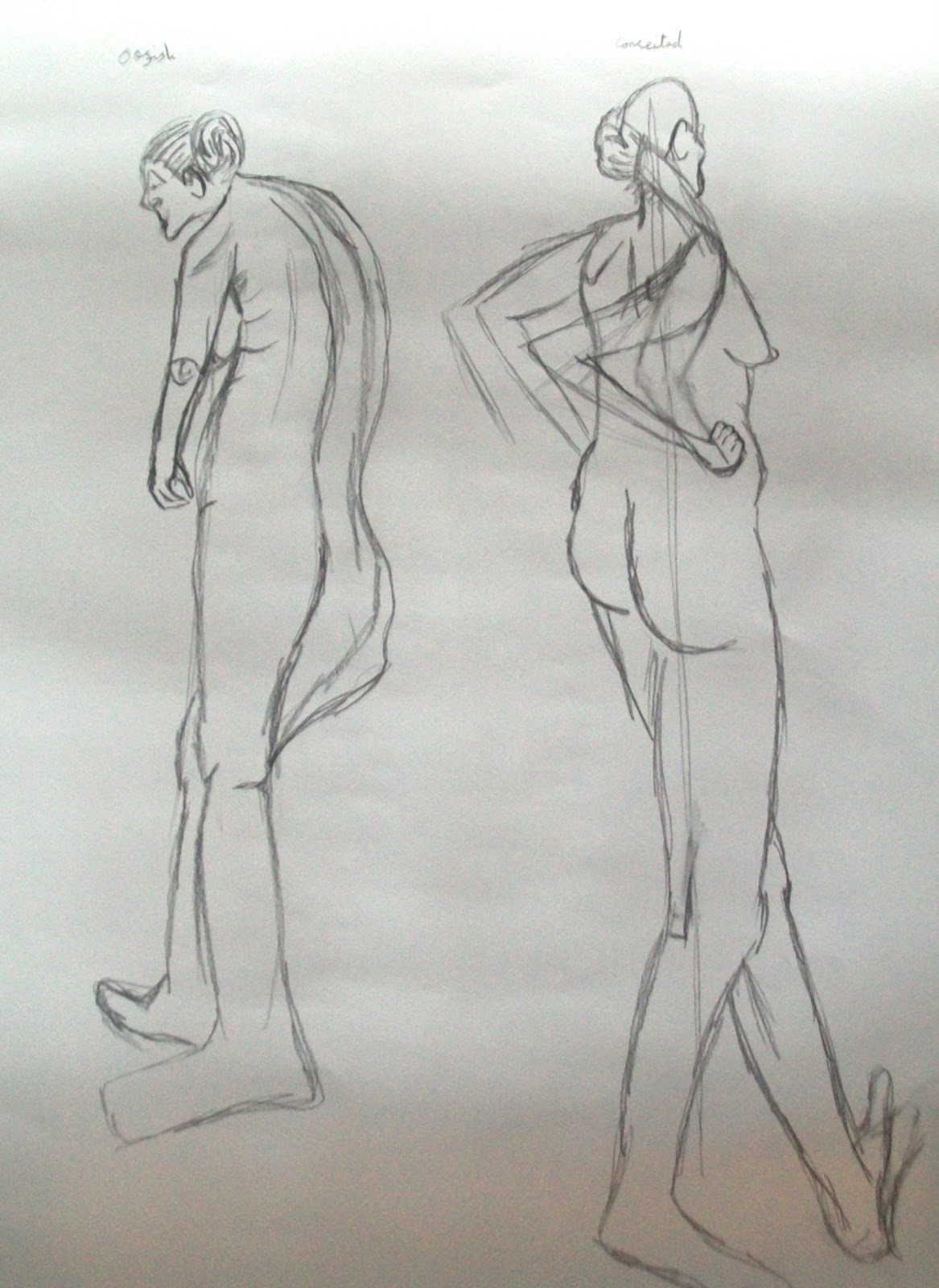 |
| Oafish and Conceited |
 |
| Devious, Petulant and Persnickety |
 |
| Geriatric and Gymnastic |
Maya - spine and complete body rig


Only had a few problems overall but was relieved to finish it. I found it a very useful learning curve to learn more about some of the features in Maya.
Animatic - The Geriatric Toadstool
I will probably hand draw the title sequences when I come to do the final animation and I haven't added a music track because I felt this might be too much.
Friday, 25 March 2011
Animation Tasks - resolved ball and camera tasks
I had to go back and look at the previous workshops and make sure that it is set at 12 frames per second and change the drawings to make the movements more fluid.
Thursday, 24 March 2011
Final Storyboard/s


This is the storyboard I have completed based on version 3 of my script and below are the sperate frames that will be used in the animatic.


The Animation Timeline - Jiri Barta (1948 - Present)


Figure 1, (2010), In the Attic

Figure 2, (2006), The Pied Piper of Hamelin
Jiri Barta is another animator influnced by the grotesque and disturbing visuals of Svankmajer, using mannequinns, abandoned gloves of wooden puppets for the central characters. Sound is emphasised in Barta's animations of blood sloshing, etc and it gives a quality of the character and their relation to the created world. "Jiri Barta is a much heralded figure in animation circles. The Czech filmmaker has built his reputation on a series of wondrously strange films that combine live-action, hand-drawn animation, and stop-motion in exciting ways." (Rich, 2006) Barta is recognised for experimenting and combining the three techniques to gain his bizarre but successful results. The Pied Piper of Hamelin is one example where these techniques are used, the rats appear as real life and then when they run on set they transform into the puppets to match the style of set and characters.

The themes of greed and gluttony are shown in Barta's town and puppet characters that feast on exotic banquets. The characters in Pied Piper drap themselves with precious jewels, whereas the townsfolk haggle at the market stalls to pay the least price possible so there is a comparrison between the villagers that live in hamelin. "The real gem here is The Pied Piper of Hamelin aka Krysar, Barta's unique puppet version of the famous story. Clocking in at about 53 minutes, it takes a leisurely tour through the story, with real rats combining with wodden somewhat cubist puppets representating the humans. Everything about the film is arresting; the architecture of the city looks as if it's erupted from the earth rather than been built, and the puppets are a beautiful range of figures and faces." (Wilson, 2006) The evidence explores how the characters and set has emotive gestures and have similarties to real life but also twisted to make the original tale dark. "Barta's film creates a striking contrast to the Disney conception of the pied piper legend as a children's comedy. Barta's adaption is a challenging and metaphoric morality that continues in the Czech tradition of Pied Piper adaptations began by Viktor Dyk in literature (Krysar, 1915)" (Kosuilca, 2002) Barta has the incoporated the original metaphors and dark symbolism in the same way that Lotte Reineger incoporated fairy tales using silhouttes. Barta has used twisted puppet forms to represent the characters of the story so that it is recognisable to the viewer who the people in the story are and what they represent in the plot.

Figure 4, (2007), The Pied Piper of Hamelin 2
Illustrations
Figure 1, (2010), In the Attic, @ http://drnorth.wordpress.com/2010/05/13/jiri-bartas-in-the-attic-the-other-toy-story/, Accessed on: 13th May 2010
Figure 2, (2006), The Pied Piper of Hamelin, @ http://www.dvdtalk.com/reviews/23937/jiri-barta-labyrinth-of-darkness/, Accessed on: 12th September 2006
Figure 3, (2011), The Vanished World of Gloves, @ http://www.kratkyfilm.cz/catalogue/print/263.htm, Accessed on: 2011
Figure 4, (2007), The Pied Piper of Hamelin 2, @ http://notcoming.com/features/jiribarta/, Accessed on: 17th June 2007
Bibliography
Kosulicova Ivana, (2002), The Morality of Horror, @ http://www.kinoeye.org/02/01/kosulicova01_no2.php, Accessed on: 7th January 2002
Rich James, (2006), Jiri Barta: Labyrinth of Darkness, @ http://www.dvdtalk.com/reviews/23937/jiri-barta-labyrinth-of-darkness/, Accessed on: 19th September 2006
Wilson Jeff, (2006), Jiri Barta, @ http://www.digitallyobsessed.com/displaylegacy.php?ID=8931, Accessed on: 14th September 2006
Subscribe to:
Posts (Atom)