Petric D + Boggs J, 2004, The Art of Watching Films edition 6, New York, Mc Graw Hill companinies
1. The Art of Watching Films
- Pg 2 - "like sculpture film manipulates three dimensional space. But like pantomime, film focusses on moving images and as in dance, the moving images in film have rhythm"
- Film focusses on full spectrum - the objective and sensual
- Pg 3 - "A Film can look to the remote past or probe the distant future; it make a few seconds seem like hours or compress a century into minutes" - period of time exprienced
- the willing to except different genres
- outside influence can effect opinions and raise expectations
- widescreen to standard tv by editing process 'Panning and scanning'
3. Fictional and Dramatic Elements
- "I don't want to film a 'slice of life' because people can get that at home, in the street, or even infront of a movie theatre... It must be dramatic and human what is drama after all, but life with the dull bits cut out? '' Alfred Hitchcock - Director
- A film that is structured centres around a central theme
- Focusses on plot, emotional effect, character, style, texture, structure or idea
- Unified plot focusses on continuous action - 1 event leads into one another naturally and logically (meant to be)
- creating the illusion of truth
- Truth in film story as an approximation of life, the human need to believe, something not there but acceptable in the situation
- A good interesting story captures interest of an audience with suspense by hinting the outcome - moving the story along. Action - stories are never static so action or change is essiential whether external or physical or within mind/emotion of the character
- keep interest throughout time limit
- viewers need to be manipulated by emotion in structure of story line
- Editing and Special Visual Effects
. a film is contibution made by the editor to complete the film from various component parts and soundtrack
. editor decides which segments to use and how long they will apear for
. combining a series of action shots combined to form a scene
- Selectivity
. selecting the best shots
. sections that are most powerful, effective or significant visual and sound effects discarding irrelevant material
. work on a five sec shot at 1 time to see sound, camera technique (focus + movement), compostion, lighting, performance + angle
- Coherence, Continuity and Rhythm
. putting pieces in a coherent order
. interrelationships of seperate images and sounds are made clear so scene runs more smoothly
- Transitions
. optical effects to form smooth divisions between two sequences in a different time or place
. Wipe - image separated from previous image by means of a horizontal, vertical or diagonal line moves across screen to wipe away previous image
- Editing sequence - Action + Reaction
. building dramatic effect and suspense by cutting back and fourth between characters or action
. Pg 168 - 173 image demonstration
. Flip Frame - entire frame flips over to reveal new scene as if turning a page
. Fade out/ Fade in - last images fade to black and first image is gradually illuminated
. Dissolve - end of the shot gradually merges into the beginning of the next
- Rhythms, Tempo and Time Control
. refers to the cuts that divide the film but still alows it to flow naturally
. the flow of story, action and dialogue acts sensitive to the music already in place in the scene
- Expansion and Compression of Time
. expanding normal sense of time e.g a whole shot of a man walking up stairs and close ups of feet
. flash cuts - quick display of images compresses an hour worth of images in quick bursts so preceeding and last scene overlaps to make quick time length seem fluid
- Creating Juxtaposition
. a montage made with images and sounds without pattern creates a visual poem
. used to create mood, atmosphere, transition in time or place or a physical or emotional impact

Monday, 31 January 2011

Notes from Exploring Storyboarding - Wendy Tumminello
Tumminello Wendy, 2005, Exploring Storyboarding, Canada, Thomson and Delmar Learning
1. Visual Producer and designer storytelling and storyboards
- Pg 2 reference of communication through visual in cave paintings passed on today through film, tv and game
- visuals versus the story "If you tell a story you try to entice the audience into imagining it's content."
- "...when you show a story, you are moulding the message into visual imagery."
- Screen play - intended as a production tool for director and crewsmembers and includes slugline; screen description and dialogue
- storyboard visually link to comic strip without dialogue balloons
3. Fundamentals of the shot
- Pg 35 - illustration of camera shots on a person
- shot description similiar to 'Make Your own Hollywood Movie' and extra includes:
. Two shot - two characters occup the frame in a number of positions
. Insert shot - close up of action or an object
- Camera angles Pg 40 - 44
. High angle shot - a camera placed higher than the subject tilted downward evokes emotional response from audience
. Low angle shot - placed lower than subject and tilted upwards usually used for characters of power or when one character is positioned higher in the frame than the other
. Eye level shot - eye level with character identifies character as equal
. Bird's Eye View - directly overhead of the action allows audience to look down on buildings and bridges within a city
. Canted shot - views an image off centre or tilted, subject appears to be diagonal and off balance
- Camera Movement Pg 46 - 52 creates dynamic motion part of the story telling process within a storyboard
. Crane shot - camera placed on crane swooping down or up, covering great distances that produce usual angles
. Tracking shot - tracks alongside of the object or person (audience can follow)
. Objective shot - camera placed in neutral position audience observes action from side lines
. Subjective shot - most personal/ interactive, camera trades places with on screen character allows audience to see action through character's eyes.
4. From Script to final Storyboard
- Pg 60 - shot list includes camera framing, angle, script description and notes (example on page)
- Pg 62 - Practical, Aesthetic and Psychological Factors
. Practical - character's viewpoint of story being told
. establishing shot anytime a new location or setting is introduced
. starting with a close up view
- Pg 70 useful process (for project)
12. Animatics
- an animatic is a moving storyboard shows how scenes flow together begins with script
- guide for movement, dialogue and action
- help to previsualise a shot
- Hand - drawn + timed storyboards help directors communicate complex action scenes
- Pencil tests + Motion previews - motion of characters and objects, camera movement, character placing and timing
- Videomatic - rough video tapped version - blocked the action, actor placement, timing and angle - use of actors or production to assist with bluescreen later removed and replaced with matte painting
- 3D animatics - computer generated instead of hand drawn - basic rules still followed
- easier to animate
1. Visual Producer and designer storytelling and storyboards
- Pg 2 reference of communication through visual in cave paintings passed on today through film, tv and game
- visuals versus the story "If you tell a story you try to entice the audience into imagining it's content."
- "...when you show a story, you are moulding the message into visual imagery."
- Screen play - intended as a production tool for director and crewsmembers and includes slugline; screen description and dialogue
- storyboard visually link to comic strip without dialogue balloons
3. Fundamentals of the shot
- Pg 35 - illustration of camera shots on a person
- shot description similiar to 'Make Your own Hollywood Movie' and extra includes:
. Two shot - two characters occup the frame in a number of positions
. Insert shot - close up of action or an object
- Camera angles Pg 40 - 44
. High angle shot - a camera placed higher than the subject tilted downward evokes emotional response from audience
. Low angle shot - placed lower than subject and tilted upwards usually used for characters of power or when one character is positioned higher in the frame than the other
. Eye level shot - eye level with character identifies character as equal
. Bird's Eye View - directly overhead of the action allows audience to look down on buildings and bridges within a city
. Canted shot - views an image off centre or tilted, subject appears to be diagonal and off balance
- Camera Movement Pg 46 - 52 creates dynamic motion part of the story telling process within a storyboard
. Crane shot - camera placed on crane swooping down or up, covering great distances that produce usual angles
. Tracking shot - tracks alongside of the object or person (audience can follow)
. Objective shot - camera placed in neutral position audience observes action from side lines
. Subjective shot - most personal/ interactive, camera trades places with on screen character allows audience to see action through character's eyes.
4. From Script to final Storyboard
- Pg 60 - shot list includes camera framing, angle, script description and notes (example on page)
- Pg 62 - Practical, Aesthetic and Psychological Factors
. Practical - character's viewpoint of story being told
. establishing shot anytime a new location or setting is introduced
. starting with a close up view
- Pg 70 useful process (for project)
12. Animatics
- an animatic is a moving storyboard shows how scenes flow together begins with script
- guide for movement, dialogue and action
- help to previsualise a shot
- Hand - drawn + timed storyboards help directors communicate complex action scenes
- Pencil tests + Motion previews - motion of characters and objects, camera movement, character placing and timing
- Videomatic - rough video tapped version - blocked the action, actor placement, timing and angle - use of actors or production to assist with bluescreen later removed and replaced with matte painting
- 3D animatics - computer generated instead of hand drawn - basic rules still followed
- easier to animate
Notes from Make your own Hollywood Movie - Ed Gaskell
Gaskell, Ed, 2004, Make your own Hollywood Movie, Lewes - East Sussex, Ilex
3. The Shoot
- Pg 36 - screenplay - advice
- Pg 37 - structure scenes as you would imagine them cut, long scenes don't exist any more because they are not popular with today's audience
- Pg 44 + 45 - Story board visual reference to script
- shows where story is going through depictions of simple scenes
- also points out introduction to sound efeects + dialogue
- Pg 60 + 61 - different camera shots:
. The Establisher - World shot
. The Long Shot - locates characters in physical order and explains how characters react to eachother's position in tighter shots
. The Medium Shot - shifts emphasis from location to character through body language and action
. The Close up - form for dialogue framing whole head and shoulders, eyeline direct conversation in context
. The Cut away - nothing in particular - carries dialogue and makes easy on the eye or ear transition
. The Extreme - close up - tighter than close up labouring on detail draws audience's ateention that character has or hasn't seen
- Prop - object or metaphor
- combination of all shots easier to cut, creates rhythm and more palatable to watch
- Pg 62 - framing shots, geometrics and vanishing points draws line of sight
- Pg 63 - editing thought while shooting e.g shooting wider on longer shot = more aesthetic and meaningful transition
- "Psychological studies have proven that some compostions are simply more pleasing to the eye."
- The Golden Section - Greeks broke down a 2-D scene into one third/ two third sections meaning frame divided into nine equal parts
- diagonals another example of forcing eye to look at one point of the image
- Camera Movements:
. zoom - camera slowly moves into subject without op moving
. pan - horizontal move used to get from 1 subject to another changing emphasis
. tilt - vertical move which can take viewer from sky to landscape or character's eye to prop
- Pg 65 - involve audience, camera ops themselves must move, taking lens into action - POV point of view, behind the eyes of an individual showing what is being viewed or participating in
4. The Final Cut
- Pg 84 - rough cut gets all clips on computer and assemble them in roughly right order - creates a moving storyboard
- DV cam - used to capture right speed
- Pg 85 - Rules section for successful clips
- Pg 86 - how clips are put in a time line creating a digital story board shows how a whole scene/s could work - professionals edit on timeline
- Pg 88 - editing begins with master shot - usually wide shot that introduces whole scene
- Pg 89 - sync clips are matched with story visual references
- Pg 90 - "Editing gives you the opportunity to create the illusion of time passing, and to change the audience's emotional responses over an hour and a half."
- dialogue scenes cut from one shot to the other every few seconds to direct audience's attention to the character talking
- Transitions such as dissolve and cross fades explains to an audience just how time is supposed to be passing - last half hour = 2 seconds or longer for gradual
- equivalent to comma in sentence
- dissolve carries audience from 1 scene to another without the harsh edge of a hard cut
- cross dissolves used in same scene to depict a confusing time through character's perspective (dreams, drink, drugs)
- fade - a great amount of time passed
- wipe reveals second scene as first is wiped away (old fashioned effect)
- Pg 96 + 97 - image reference to cut scenes
- Pg 102 - colour correction changes scenes into technicolour, b/w, monochrome and time of day
- Pg 106 - 109 - importance of movie titles
. opening titles
. credits
. in - movie titles
3. The Shoot
- Pg 36 - screenplay - advice
- Pg 37 - structure scenes as you would imagine them cut, long scenes don't exist any more because they are not popular with today's audience
- Pg 44 + 45 - Story board visual reference to script
- shows where story is going through depictions of simple scenes
- also points out introduction to sound efeects + dialogue
- Pg 60 + 61 - different camera shots:
. The Establisher - World shot
. The Long Shot - locates characters in physical order and explains how characters react to eachother's position in tighter shots
. The Medium Shot - shifts emphasis from location to character through body language and action
. The Close up - form for dialogue framing whole head and shoulders, eyeline direct conversation in context
. The Cut away - nothing in particular - carries dialogue and makes easy on the eye or ear transition
. The Extreme - close up - tighter than close up labouring on detail draws audience's ateention that character has or hasn't seen
- Prop - object or metaphor
- combination of all shots easier to cut, creates rhythm and more palatable to watch
- Pg 62 - framing shots, geometrics and vanishing points draws line of sight
- Pg 63 - editing thought while shooting e.g shooting wider on longer shot = more aesthetic and meaningful transition
- "Psychological studies have proven that some compostions are simply more pleasing to the eye."
- The Golden Section - Greeks broke down a 2-D scene into one third/ two third sections meaning frame divided into nine equal parts
- diagonals another example of forcing eye to look at one point of the image
- Camera Movements:
. zoom - camera slowly moves into subject without op moving
. pan - horizontal move used to get from 1 subject to another changing emphasis
. tilt - vertical move which can take viewer from sky to landscape or character's eye to prop
- Pg 65 - involve audience, camera ops themselves must move, taking lens into action - POV point of view, behind the eyes of an individual showing what is being viewed or participating in
4. The Final Cut
- Pg 84 - rough cut gets all clips on computer and assemble them in roughly right order - creates a moving storyboard
- DV cam - used to capture right speed
- Pg 85 - Rules section for successful clips
- Pg 86 - how clips are put in a time line creating a digital story board shows how a whole scene/s could work - professionals edit on timeline
- Pg 88 - editing begins with master shot - usually wide shot that introduces whole scene
- Pg 89 - sync clips are matched with story visual references
- Pg 90 - "Editing gives you the opportunity to create the illusion of time passing, and to change the audience's emotional responses over an hour and a half."
- dialogue scenes cut from one shot to the other every few seconds to direct audience's attention to the character talking
- Transitions such as dissolve and cross fades explains to an audience just how time is supposed to be passing - last half hour = 2 seconds or longer for gradual
- equivalent to comma in sentence
- dissolve carries audience from 1 scene to another without the harsh edge of a hard cut
- cross dissolves used in same scene to depict a confusing time through character's perspective (dreams, drink, drugs)
- fade - a great amount of time passed
- wipe reveals second scene as first is wiped away (old fashioned effect)
- Pg 96 + 97 - image reference to cut scenes
- Pg 102 - colour correction changes scenes into technicolour, b/w, monochrome and time of day
- Pg 106 - 109 - importance of movie titles
. opening titles
. credits
. in - movie titles
Notes from An Introduction to Film studies - Edited by Jill Nelmes
Nelmes Jill, 1996, An introduction to Film studies, Canada, Routledge
4. Film, form and narrative (Allan Rowe)
- Mise - en - scene - derived from the french term 'having been put into the scene', visual aspects put into a single shot
- elements needed by the camera, objects, movements, lighting, shadow, colour, etc
- setting - context of studio shooting
- Function to place performers with purpose creating own space and meaning
- props are important for conveying meaning and genre, scenes are constructed around a number of props to make them feel right
- Performance and movement - body language, part of language of the film that helps scenes to flow
- lighting intention to highlight where action, dialogue, etc but can also be characterised by it's absense
- Steadicam - opition of greater flexibility and choice - movement and angle, different ratios and variety of screen formats
- shots are perceived as naturalistic and replicate the natural movements of the eye
- Editing - combination of shots constructing a flowing film over time
- "New wave directors felt free to ignore these conventions if the viewer was able to identity the passing of time through what was happening in the narrative."
- establishing shot - a long shot allows spectator to become a part of the space of the scene
- 180 degree rule - an imaginary line between actors in conversation or direction of a chase
- 30 degree rule - successive shot in same area involving a 30 degree change in angle or substantial change in view point
- " Narrative involves the viewer in making sense of what is seen, asking questions of what we see, asking questions of what we see and ancipating the answers
4. Film, form and narrative (Allan Rowe)
- Mise - en - scene - derived from the french term 'having been put into the scene', visual aspects put into a single shot
- elements needed by the camera, objects, movements, lighting, shadow, colour, etc
- setting - context of studio shooting
- Function to place performers with purpose creating own space and meaning
- props are important for conveying meaning and genre, scenes are constructed around a number of props to make them feel right
- Performance and movement - body language, part of language of the film that helps scenes to flow
- lighting intention to highlight where action, dialogue, etc but can also be characterised by it's absense
- Steadicam - opition of greater flexibility and choice - movement and angle, different ratios and variety of screen formats
- shots are perceived as naturalistic and replicate the natural movements of the eye
- Editing - combination of shots constructing a flowing film over time
- "New wave directors felt free to ignore these conventions if the viewer was able to identity the passing of time through what was happening in the narrative."
- establishing shot - a long shot allows spectator to become a part of the space of the scene
- 180 degree rule - an imaginary line between actors in conversation or direction of a chase
- 30 degree rule - successive shot in same area involving a 30 degree change in angle or substantial change in view point
- " Narrative involves the viewer in making sense of what is seen, asking questions of what we see, asking questions of what we see and ancipating the answers
Notes from Film A Critical Introduction 2nd Edition - Maria Pramaggiore and Tom Wallis
Wallis Tom and Pramaggoire Maria, 2008, Film A Critical Introduction, London, Lawrence King Publishing LTD
4. Narrative Form
- understanding throughout, one crucial movement in the beginning could explain certain scenes to come
- "Choices regarding how and when to present information about characters contributute to the overall storytelling frame work of the film"
- Narrative usually focusses on human characters and struggles - perform actions and undergo changes in pursuit of a specific goal
- Obstacles to overcome e.g LOTR Frodo toresist the evil of the ring
- diegesis -implied world of the story - settings, characters, sounds and events
- non - diegetic/ extradiegetic - elements that exsist outside the implied world
- music can form both, fitting into the theme
- film doesn't depict every moment of character's lives, certain events left out
- Syuzhet ( russian term for transforming a complete chronological story into an abbreviated version of events played to audience) - the ordering of the actions presented on screen
- fabula - story- narrative - syuzhet - plot
- use of flash backs/ fowards interrupt film's present tense or rearrange the chronological order
- syuzhet can manipulate frequency of events - how many times an act can occur, often from the perspective of different characters
- pattern for narrative films are 3 act structure - introducing characters, goals and conflicts leading onto a turning point - a sudden change, eventually leading to closure - tie up of loose ends
- Film scholar Kristen Thompson argues the 4 part structure including a turning point at midway
- Table of explanation Pg 68
- Point of view shots - when audience shares visual perspective of a character/s informing their intentions, motivation and experience of world
7. Editing
- Editing contribututes aesthetic quality of a film
- one basic principal is joining two shots together transcends visual information contained in individual shots
- The Kuleshov effect - one shot that has association with preceding and succeeding shots
- Audience formulate ideas and derive meaning from the comparrison of each shot
- Abrupt camera changes can evoke an emotional response e.g dialogue scenes can convey power combinations of continuty
- visual imagery is also effective
- Tempo in editing 2 factors
1. length of shot
2. Type of shot transition - visual effect used to move from 1 shot to next
- average shot length of 5.15 secs for 1 shot, allows audience to respond to rhythm and 3 secs to adjust to new shot
Transition - dissolve, wipe, iris in, iris out
- a brupt change draws attention to sudden shift in emotional weight of scene
- effects pace of sequence, a fade - a visual pause in sequence of action
- dissolves, fades, irises and wipes rarely occur within a scene and are used to introduce a memory or a fantasy
- Pg 199 Table - three attributes of editing in Notorious (example)
- Tableu shot - Long shot where frame resembles proscenium arch of a stage, audience's perspective distanced from action on screen
- shot/ reverse shot - character speaking followed by another character's response
- eye line match - shot of character looking at something off screen - shows thought process
- cutting to Emphaisis Group Dynamics - cut to specific areas focussing on certain traits or goals character has
- Cutaways - drawn attention of non human elements in mise - en - scene/ appearance of an object
4. Narrative Form
- understanding throughout, one crucial movement in the beginning could explain certain scenes to come
- "Choices regarding how and when to present information about characters contributute to the overall storytelling frame work of the film"
- Narrative usually focusses on human characters and struggles - perform actions and undergo changes in pursuit of a specific goal
- Obstacles to overcome e.g LOTR Frodo toresist the evil of the ring
- diegesis -implied world of the story - settings, characters, sounds and events
- non - diegetic/ extradiegetic - elements that exsist outside the implied world
- music can form both, fitting into the theme
- film doesn't depict every moment of character's lives, certain events left out
- Syuzhet ( russian term for transforming a complete chronological story into an abbreviated version of events played to audience) - the ordering of the actions presented on screen
- fabula - story- narrative - syuzhet - plot
- use of flash backs/ fowards interrupt film's present tense or rearrange the chronological order
- syuzhet can manipulate frequency of events - how many times an act can occur, often from the perspective of different characters
- pattern for narrative films are 3 act structure - introducing characters, goals and conflicts leading onto a turning point - a sudden change, eventually leading to closure - tie up of loose ends
- Film scholar Kristen Thompson argues the 4 part structure including a turning point at midway
- Table of explanation Pg 68
- Point of view shots - when audience shares visual perspective of a character/s informing their intentions, motivation and experience of world
7. Editing
- Editing contribututes aesthetic quality of a film
- one basic principal is joining two shots together transcends visual information contained in individual shots
- The Kuleshov effect - one shot that has association with preceding and succeeding shots
- Audience formulate ideas and derive meaning from the comparrison of each shot
- Abrupt camera changes can evoke an emotional response e.g dialogue scenes can convey power combinations of continuty
- visual imagery is also effective
- Tempo in editing 2 factors
1. length of shot
2. Type of shot transition - visual effect used to move from 1 shot to next
- average shot length of 5.15 secs for 1 shot, allows audience to respond to rhythm and 3 secs to adjust to new shot
Transition - dissolve, wipe, iris in, iris out
- a brupt change draws attention to sudden shift in emotional weight of scene
- effects pace of sequence, a fade - a visual pause in sequence of action
- dissolves, fades, irises and wipes rarely occur within a scene and are used to introduce a memory or a fantasy
- Pg 199 Table - three attributes of editing in Notorious (example)
- Tableu shot - Long shot where frame resembles proscenium arch of a stage, audience's perspective distanced from action on screen
- shot/ reverse shot - character speaking followed by another character's response
- eye line match - shot of character looking at something off screen - shows thought process
- cutting to Emphaisis Group Dynamics - cut to specific areas focussing on certain traits or goals character has
- Cutaways - drawn attention of non human elements in mise - en - scene/ appearance of an object
Notes from Film Studies - Warren Buckland
Buckland, Warren, 2003, Film Studies, Chicago, Contemporary books
1. Film aesthetics: Formalism and realism
- Mise - en - scene 'putting on stage' originates from the theatre
- in book: 'What appears in front of the camera - set design, ligting and character movement
- Mise - en - shot - shooting or filming
- Film makers make a productive relationship between the two
- long take - shot of long duration - according to Barry Salt average of Hollywood shots is 9 secs in 1940 so any duration past this is a long take
- Deep focus photography - keeps several planes of the shot in focus at same time (foreground, middleground and background)
- combined with long take so camera can stay in one place with slight movement for reframing (popular with Orsen Welle's films)
- Pg 14 quote by Orson Welles explaining it's importance
- Continuity editing - shots controlled and regulated in a series
- Continuity editing enables viewer to create coherent picture from the shots presented on screen
- other techniques:
. eye line match
. point of view cutting
. match on action cut
. directional continuity
- editing breaks down a scene into a multitude of shots and gives director complete control over events and actors
- advantage of editing over long take and deep focus is changes in viewpoint can fully involve the spectator in action
- example pg 20 'Editing in Jurrassic Park'
- "Colour can be manipulated to create an atmosphere"
- montage creates symbolic meanings by juxtaposing shots together
- "Associations" (in words of Einstein, that didn't exist before
2. Film Structure: narrative and narration
- narrative structure consists of a series of elements related to one another in terms of cause and effect
- scenes as well as shots are also linked together for a cause - effect narrative logic
- narrative development is dependant on the way in which caused - effect logic is worked out in relation to film's character/s
- Tzvetan Todorov describes narrative in 3 terms pg 36:
1. a state of equalibrium
2. the disruption of this equilibrium by an event
3. the successful attempt to restore the equlibrium
- transition from one stage to next is the narrative's 'turning point'
- middle part is characterised as liminal or transition period - meaning it takes place outside of social events
- additional elements of narrative structure include: exposition, dangling causes, obstacles, dealines and dialogue hooks
- Thompson defines 'dangling cause' as "information or action that leads to no effect or resolution until much later in the film". Pg 39
- The dealine is time limit placed to accomplish a goal
- dialogue hook creates a link between 2 consecutive scenes
- Pg 43 restricted and omniscient narration
- Restricted - the camera filters the narrative only through the vision of one character
- Omniscient - the camera jumps from one character to the next or no characters (the camera filters the narrative through the director's vision)
- sometimes omniscient narration the camera will disengage from all characters in case narration is controlled by someone outside - director
- narration is a mechanism that determines how information is conveyed to the spectator
1. Film aesthetics: Formalism and realism
- Mise - en - scene 'putting on stage' originates from the theatre
- in book: 'What appears in front of the camera - set design, ligting and character movement
- Mise - en - shot - shooting or filming
- Film makers make a productive relationship between the two
- long take - shot of long duration - according to Barry Salt average of Hollywood shots is 9 secs in 1940 so any duration past this is a long take
- Deep focus photography - keeps several planes of the shot in focus at same time (foreground, middleground and background)
- combined with long take so camera can stay in one place with slight movement for reframing (popular with Orsen Welle's films)
- Pg 14 quote by Orson Welles explaining it's importance
- Continuity editing - shots controlled and regulated in a series
- Continuity editing enables viewer to create coherent picture from the shots presented on screen
- other techniques:
. eye line match
. point of view cutting
. match on action cut
. directional continuity
- editing breaks down a scene into a multitude of shots and gives director complete control over events and actors
- advantage of editing over long take and deep focus is changes in viewpoint can fully involve the spectator in action
- example pg 20 'Editing in Jurrassic Park'
- "Colour can be manipulated to create an atmosphere"
- montage creates symbolic meanings by juxtaposing shots together
- "Associations" (in words of Einstein, that didn't exist before
2. Film Structure: narrative and narration
- narrative structure consists of a series of elements related to one another in terms of cause and effect
- scenes as well as shots are also linked together for a cause - effect narrative logic
- narrative development is dependant on the way in which caused - effect logic is worked out in relation to film's character/s
- Tzvetan Todorov describes narrative in 3 terms pg 36:
1. a state of equalibrium
2. the disruption of this equilibrium by an event
3. the successful attempt to restore the equlibrium
- transition from one stage to next is the narrative's 'turning point'
- middle part is characterised as liminal or transition period - meaning it takes place outside of social events
- additional elements of narrative structure include: exposition, dangling causes, obstacles, dealines and dialogue hooks
- Thompson defines 'dangling cause' as "information or action that leads to no effect or resolution until much later in the film". Pg 39
- The dealine is time limit placed to accomplish a goal
- dialogue hook creates a link between 2 consecutive scenes
- Pg 43 restricted and omniscient narration
- Restricted - the camera filters the narrative only through the vision of one character
- Omniscient - the camera jumps from one character to the next or no characters (the camera filters the narrative through the director's vision)
- sometimes omniscient narration the camera will disengage from all characters in case narration is controlled by someone outside - director
- narration is a mechanism that determines how information is conveyed to the spectator
Unit 4
The three choices I got:
Environment: Ware house
Character: Frogman
Prop: Trombone
a random selection that will hopefully inspire a wacky narrative.
Environment: Ware house
Character: Frogman
Prop: Trombone
a random selection that will hopefully inspire a wacky narrative.
Saturday, 22 January 2011
Maya - Sampler Nodes
 |
| Blood Vessels |
 |
| Book - left side |
 |
| Book - right side |
 |
| Water Droplets on leaf |
 |
| Xray Teeth |
All these tasks taught me how to set up nodes in Hypershader and make objects feel more realistic. They were really simple but I had problems with the book page tutorial as Alan's table texture would not load so that is the reason for the black background.
Thursday, 20 January 2011
Blue Velvet Directed by David Lynch


This characters of Jeffrey and Frank are closely linked within the themes of surreal and dark because there are subtle links between them, the obvious is the fascination with Dorothy. Frank is the typical villian holding a member of the family hostage and raping the woman he is black mailing but the character also had a breathing disability which showed a sign of humanity. Frank was a mainly a character to be feared because even with the disability, there was presence and power when he entered the apartment scene and started to force Dorothy to satisfy his desires. There were hints that Frank might have been insaine, one example is when he is appling lipstick and kisses Jeffrey, which seemed to indicate that the character was a metaphoric monster as he was not afraid to unleash his dark identity on the other characters. Jeffrey is a detective but his job is put into question when he is found hiding in the closet of Dorothy's apartment, which looked like he was a pervert. This means that the most honourable men could be twisted within the dark mean changing the perception of what there intentions are. Sandy discovered that Jeffrey was close with Dorothy and her perception of what kind of person he is changed, symbolising something dark that was conceallled has now been revealed into the open. 'some ways, the two male leads represent the two dichotomous sides of life (e.g., light/dark, normalcy/aberration, attraction/repulsion, innocence/expriences, perversion/love, virtue/base desires, etc.) that struggle for dominance' (Dirks, 2010), the quote explains how the line between opposites are crossed so that a particular scene could have a hidden dark meaning.

Figure 1, 2010, Frank blackmailing Dorothy
There was a sense of eerieness in the sets because there were two time periods merged together. The houses were nineteen sixies but apartment set was designed as it would of looked in the eighties, this clash created a fantasy America with conflicting themes. Lynch is famous for making his films dark and twisted but this film was a lot more subtle because real themes were slightly bent to fit the theme of the story. 'And so begins Blue Velvet, an abrasive, original look at violent and perverted behaviour that could have only come from the mind of David Lynch' (French,2001), this evidence implies that Lynch focusses on the dark perception on very basic real themes and that he creates a fantasy world around this to create disturbing and uncomfortable tension. An example is violence because a lot of films would usuallly show the excitment and the thrill that comes from the adreline but this film focussed on capturing the horror and evil that it really is. The closet where Jeffrey hides to spy on Dorothy has a great cropped view so that he could only see a sliver of the space. Also the use of little light pouring through the slits on the door really made the space feel small and claustrophobic. The scene where Dorothy is left naked on the lawn has a simliar appearance to a Gregory Credson photograph because it was at night and if the purpose was not known, it could create a lot of meanings around the themes of abandonment and protestution.

Figure 2, 2011, Jeffrey hiding in closet

Figure 3, 2007, Dorothy's apartment
The song 'Blue Velvet seemed to a flowing connection throughout because it was the only song Dorothy would sing in the bar as if their was some personal connection. The song also effected Frank emotionally because in one scene he is crying so this could mean he had a deep connection with the song or a syptom of his insainty that relaxes him. Even the soundtrack would play the song Blue Velvet at the points in the film where Jeffrey and Dorothy were making love or kissing. The rest of the soundtrack was strong keeping to the rules of the two separate rules of the two eras. The songs for the sixties city was calm and represented everyday life but the track for the apartment scenes built up tension and typical for an eerie space.
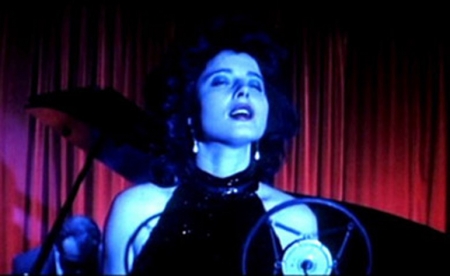
Figure 4, 2010, Dorothy singing
The ending was disturbing because it was perfectly tied up and 'they all lived happy after' scenerio, which is not expected in a Lynch film. It was depicted as if the experience hasn't effected either Jeffrey or Sandy, especially considering some of his hidden secrets with his dealings with Dorothy but they seem oblivious to this. However when all the characters stop to stare at a bird perched outside the window, it looks like it is made from clock work, identifying that this perfect world could be another fake creation. It also indicates that this world has the potiential of turning dark and falling into a twisted surreal dream. 'The time period is unsettled. It more or less seems to be taking place in the present day, but it mashes together elements from several eras.' (Hanke 2010), Hanke sums up how the themes could appear confusing to a viewer in Lynch' s clever twisted style and therefore implies how this ending has alot of hidden dark elements that have not quite revealed themselves in the open.
Illustrations
Figure 1, Visible Justin, (2010), Frank blackmailing Dorothy, @ http://mubi.com/topics/12795, Accessed on: 30th June 2010
Figure 2, Richards Deke, (2011), Jeffrey hiding in closet,@ http://www.posterpalace.com/categorysearch.lasso?-Token.category=mystery, Accessed on: 2011
Figure 3, Day Borris, (2007), Dorothy's apartment, @ http://www.flickr.com/photos/19971779@N00/358808656, Accessed on: 15th January 2007
Figure 4, Parks Matthew, (2010), Dorothy singing, @ http://mubi.com/topics/12795, Accessed on: 2008
Bibliography
Dirks Tim, (2010), Film site, @ http://www.filmsite.org/blue.html, Accessed on: 1st January 2000
French Blake, (2001), Filmcrictic.com, @ http://www.filmcritic.com/reviews/1986/blue-velvet/, Accessed on: 25th October 2001
Hanke Ken, (2010), Blue Velvet(R), @ http://www.mountainx.com/movies/review/blue_velvet, Accessed on: 30th June 2010
Digital Set Pipeline Renders and Final Scene
 |
| Final Scene |
 |
| Beauty Pass |
 |
| Ambient Occlusion Pass |
Digital Set Pipeline Light tests
 |
 |


The above images are all experiments with lights and camera positions. I tried area lights, point lights and directional lights to work out how much light I wanted to flood in to create the creepy atmosphere. I also looked at intensity, thinking about how much light I want fill the front and back of the scene. I decided that three area lights around the front and a point light in the centre were most successful.

This is the lighting I chose because it is close to what I envisioned in the concept. The matte painting can still be seen but also a wall of shadow concelling what is blocking the door way. The rest of the room has been subtlley lit for an errie atmosphere.
Matte painting
 |
| Final matte painting - darker |
This is the final matte painting that I will use for the final scene it depicts a door leading into a cell but the entrance is block with a broken wheel chair. I had to darken the painting so that it represents what we can make out in the darkness. Below I have included all development and preparatory steps taken to reach this stage.
 |
| Began blocking out painting |
 |
| Experimenting with a narrow distance perspective |
 |
| Experimenting with a closer perspective adding the broken wheel chair and open door |
 |
| adding skirting boards and door frames |
 |
| starting to increase shadow |
 |
| More shadow and texture for the door |
 |
| Experimenting - pushing the close view back and strenching out walls, floor and ceiling |
 |
| Adding shadow to match the back image |
 |
| Adding shadow and green highlight |
 |
| Bringing back image foward again |
 |
| Lightened image and deleted green highlights so can be lit with scene in Maya |
Digital Set Pipeline Texture maps - Textured scene
 |
| Texture map - bottom skirting board colour |
 |
| Texture map - bottom skirting board bump |
 | ||||||||||||||||
Texture map - bottom skirting board spec
 Texture map - ceiling and floor spec
 Texture map - walls spec
These are all the texture maps for various objects in the scene I decided to be seletive with the maps because I didn't want the scene to be over filled with texture. I produced bump and spec maps to make the selected textures more realsitic than just a flat image.   |


These are shots of the textured model, I had to edit the bump values down to lower the level of texture. I had a few problems adding the textures because the file was not recognised but I resolved this by recreating the maps.
Subscribe to:
Posts (Atom)